Showing posts with label 9th grade. Show all posts

Monday, September 21, 2015

9 Ways to Find the Best College for You

From: http://time.com/money/4025938/find-the-best-college-for-you/


Build your own personalized college rankings using these important criteria.

Lots of magazines and websites publish lists of the “best colleges.” But those general purpose rankings may not put enough emphasis on the factors that are most important for you.
Finding a college that will be the best value for you is a little like choosing the best-value car. It won’t necessarily be the cheapest. It’s the one that will take you where you want to go in life at the most reasonable price.
MONEY’s annual Best Colleges list ranks schools based on 21 factors in three key categories: educational quality, affordability, and the career success of graduates. You can use many of these same criteria to identify the schools that will provide the best value for your particular student and financial situation. Here’s how and where to find the information you need.
QUALITY OF EDUCATION
1. Check on graduation rates. Research shows that graduation rates are the single best indicator of a college’s quality; students who don’t receive adequate support or don’t think they’re getting their money’s worth are more likely to transfer or drop out. Colleges are required to report their six-year graduation rates. Look for a rate of no less than the median for similar schools: 48% at public colleges and 58% at private ones.
HOW TO FIND IT: Collegeresults.org allows you to compare 4-, 5-, and 6- year graduation rates for your target college and similar schools. If your target college isn’t in the top half of the Collegeresults.org comparison, consider some schools that are above it.
2. Compare class sizes. Research shows that personal attention from professors pays off: Students who are mentored by a professor are 50% more likely to thrive in their careers, according to Gallup research. One good indicator is the percentage of each school’s classes with 20 or fewer students.
HOW TO FIND IT: Look up your colleges on Collegedata.com. Click on the academics tab.
3. Look beyond test scores. The average ACT or SAT scores of incoming freshmen will help you see how you’d stack up academically compared with other students. But even more important than those numbers is how well the college helps its students exceed expectations, given their academic and economic backgrounds.
HOW TO FIND IT: The MONEY College Planner gives each school a “Value Added” grade. A’s or B’s generally indicate better graduation rates and alumni earnings than other schools with similar students.
AFFORDABILITY
4. Maximize your merit aid odds. More than 90% of colleges give some merit aid. Your chances of getting a substantial amount will be best at private colleges where your grades and test scores put you in the top 25% of applicants.
HOW TO FIND IT: Collegedata.com provides information on the number and size of different kinds of aid awards. The premium search filters on theMoney College Planner allow you to build a list of schools that meet your criteria and are generous with need-based and/or merit-based aid.
5. Know your real cost. Don’t pay too much attention to the college’s official cost of attendance. Nearly 60% of students pay less than that. What you want to focus on is net price.
HOW TO FIND IT: Use the net price calculator on each college’s web site for an estimate of what you’ll have to pay based on your family’s income and resources. If you want to compare several colleges’ net prices at once try CollegeAbacus.org.
6. Calculate the full cost of a degree. Look beyond freshman year to calculate what each college would cost you for the four, or possibly more, years it could take to earn a degree. The best colleges graduate students in 4.5 years or less.
HOW TO FIND IT: The MONEY College Planner shows the average net price of a degree at 700+ colleges, based on factors including how long it takes students to graduate.
STUDENT OUTCOMES
7. Expect strong job help. An active, well-staffed career services office can help students write résumés, practice for job interviews, and connect with influential alumni. Colleges should have at least one career services staffer per 1,000 students, and follow industry standard best practices.
HOW TO FIND IT: Call or visit the career services office to ask.
8. Investigate internships. The best colleges help students get internships, which not only provide real-world experience but also increase the odds of landing a good job after graduation. Students who have had paid internships, research shows, are 70% more likely to get a job offer than those who had no internships or who had only unpaid internships.
HOW TO FIND IT: Call or visit the career services office to ask what it does to help place students. Also ask how many internships—especially in your major—are paid.
9. Check up on alumni earnings. The salaries of recent grads are a good indicator of how much employers value a degree from a particular school.
HOW TO FIND IT: Payscale.com lists average early and mid-career earnings for the graduates of most large colleges. Generally, your choice of college has greater impact on early career earnings than on mid-career salary, so that’s the more important number.

Thursday, June 11, 2015

How to Deal With Your Teen’s Anger

https://www.teenlife.com/blogs/articles/how-to-deal-with-your-teens-anger

When your cherubic, smiling little person seems to transform into a rampaging angry ball of hormones overnight, it can be hard to handle. While it is common for teens to direct their rage towards the people they feel safest with (that’s you), it is often very difficult for parents to deal with.

Why Teens Get Angry With Parents

Teenagers are dealing with hormones and rapid mood changes, and it is usually mom and dad who bear the brunt of teenage angst and anger. Instinctively, teens know that parents are invariably going to take whatever is thrown at them, which provides them with the perfect battering ram to vent their hostility at the world. To make matters worse, most of us are pretty ill-equipped in knowing how to deal with strong emotions such as rage, and often feel powerless and useless.
There are many underlying causes for anger in teens, such as fear, frustration, sadness and embarrassment. Anger is often triggered by a sense of not being in control, which is a very common reaction for teens who are becoming increasingly mature and ready to face the world, yet are still tied by the constraints of parents.

How to Cope With an Angry Teen

The fundamental rule of dealing with an angry teen is to stay calm yourself. Easier said than done though, right? As the parent you need to be in command, and if you are not in control of your emotions, the situation can quickly spiral. You need to show your teen how to react under times of stress, and if you are furious, hostile, accusatory, or issuing verbal attacks, you are sending entirely the wrong message.
As with toddlers, pick your battles. If something isn’t life-threatening, don’t try to enforce it just for the sake of it. You will also quickly get a good idea of your teen’s anger triggers, and approach these subjects with caution-- and only when you are in the right frame of mind yourself.
If you feel that things are starting to become fraught, then you need to give your teen space; tell them you will leave the room for 30 minutes while they calm down and that you will return to discuss the matter later. Similarly, don’t force the issue when your teen is angry, as this will only magnify the intensity. Giving your teen- and yourself- a breather and the opportunity to calm down will help diffuse a tense situation.
It is also important to recognize the difference between anger and verbal aggression and violent behavior. If you are frightened of your teen, or they have lashed out and physically hurt you, then you will need to seek help. Intense anger and violence are often symptoms of other underlying issues and should be addressed with a medical professional.

Helping Your Teen Deal With Their Anger

Anger is a very scary emotion, for the people on the receiving end and especially for the teen experiencing it. Intense rage in teens is often debilitating, eliciting a sense of being powerless or out of control; it can also bring with it extreme guilt and feelings of self-disgust. Nobody wants to shout and scream at their parents and the wake of anger can leave them feeling confused and upset.
You should explain that anger is a normal emotion and that they shouldn’t feel guilty; however, it is not okay to rage at someone. If you allow it to persist unchallenged, kids will receive the subliminal message that it is acceptable to act in this way, which will only deepen the problem.
Therefore, make it crystal clear that although you empathize with their anger, and get why they are upset, repeated angry outbursts and threatening or aggressive behavior will never be tolerated. Although they often seem to rebel and fight against your rules at every turn, teens need strict boundaries more than ever, so ensure that you enforce consequences, such as loss of privileges, if it continues.
Always talk about their anger and explosive emotions when you are both calm, and try to explore if there is an underlying reason behind their outbursts. Look at positive ways in which teens can healthily relieve their anger, such as through sports, creative activities, or playing loud music; each child will be different, so whatever helps them de-stress is what you need to get them to focus on.
Remember that even enraged teens want their parents’ approval (although they’d never admit it in a million years). It’s not easy dealing with someone who is hostile at every turn, but the message you need to send loud and clear is that you love them, even when they are cross.

Thursday, May 14, 2015

How Not to Be a High School Helicopter Parent

From: http://www.usnews.com/education/best-high-schools/articles/2015/05/12/how-not-to-be-a-high-school-helicopter-parent

The change from middle school to high school, while daunting to students, can be equally anxiety-inducing for parents. 
For adults, the pressure to have their children get the right grades, do the right activities and get into the right college can sometimes seem overwhelming. Enter the helicopter parent – the well-intentioned mother or father who hovers so close to their teen that the child nearly gets lost in the propeller's dust cloud.
Helicopter parents have become "a colossal issue in the United States today," says Mark Reford, vice chair of BASIS Independent Schools, which runs private schools in California and New York.
Adults who prefer to keep a little more distance than helicopter parents –  to act more like airplane or satellite parents, to extend the metaphor – can easily help their children without going too far. Parents can follow these tips to make sure they are not crossing any lines. 
1. Avoid putting too much pressure on students to get good grades: While it's important for students to strive to do well in high school, putting too much emphasis on grades can backfire and make teens overly worried, says Darren Ritch, a parent of a high school student at Florida's West Port High School.
While he knows that parents shouldn't be checking their child's grades obsessively, he says he's been guilty of that behavior.   
"My son told me straight out, 'Hey Dad, you need to allow me to show you that I can be successful – you need to give me the space to show you that I can get this done,'" says Ritch. "You create a certain level of anxiety in your child if you are hovering over them every single night. You have to give them a little bit of rope." 
Even in the face of a looming C or D, parents should resist picking up a pencil and doing the work for their teen, experts say.

"Homework is supposed to be practice for the kid to get better," says Rhonda Buss, principal at California's Whitney High School. "If someone is doing it for them, then they aren't being prepared and it's actually cheating the kid."
2. Don't get too invested in the college application process: As appealing as it can be to live vicariously through a child, some parents may need to put their Ivy League dreams aside and realize their teens have different priorities, experts say.

"There are always those parents who are so totally involved in high school and then the college process and getting their kids internships," says Marian Casey, a parent of two high school students and one middle school student in private schools in Austin, Texas. "The parents are so stressed out about it and then in turn the kids are stressed out. I know that in high school they are supposed to be achieving a lot, but they are also still kids." 
3. Treat teachers with respect: While not every high teacher is going to be off-the-charts​ excellent, parents should keep in mind that most educators have the best of intentions, experts say. 
With that in mind, parents upset about what's happening in the classroom should think twice before firing off a terse email, leaving an angry voice mail​ or storming up to teachers after school. The behavior won't do your teen​ any favors and it ends up hurting faculty morale, Reford says.
"People really need to remember there is a human being who receives that email or that phone call – it can be incredibly painful for the teacher," Reford says. "Wait, and let your kids handle it. All of this gives emotional relief, but is it really what your kid needs?" 
4. Don't be in touch too often: "If you have a child in high school and you are touching base with your kid's teachers on a daily or weekly basis then you are profoundly disempowering your child," Reford says. "The message you are sending is, 'I don’t trust you to handle yourself.' Kids are really good at picking up the unspoken messages of adult behavior." 
High school is a time where parents need to allow their students to fail, experts say. Adults need to loosen their grip, let their children be independent and try to solve problems. 
As Casey puts it, "This is their world, and you do have to work hard to stay in the background."
But that doesn't mean parents have to stop advocating for their children, experts say. When Casey's oldest son ​was falling asleep during his first class, she decided to nudge him toward coffee. 
"We put a Keurig in my 10th-grader's​ bathroom and he drinks it on the way to school," she says. "You don’t have to tell them anything – ​we just work behind the scenes." 

Thursday, April 30, 2015

Your Crucial 1st Step Before Looking for Colleges

http://www.thecollegesolution.com/your-crucial-1st-step-before-looking-for-colleges/

If paying for college is going to be a challenge, and it usually is, it’s important that you obtain your Expected Family Contribution before your begin looking at colleges with your teenagers.
In fact, obtaining your EFC should be the FIRST STEP you take in the college process.
Here is a quick rundown of what an EFC is, why it’s important, how you can obtain this critical figure and what you should do after you’ve generated  it.

No. 1:

An Expected Family Contribution is a dollar figure that represents what financial aid formulas believe you should be able to pay for one year of a child’s college education.
Families with adjusted gross incomes of $24,000 have an automatic EFC of $0. The EFC for the average American household with an AGI of $55,000 will usually range from $5,000 to $6,000. There is no cap on EFCs so some wealthy families will have EFCs that exceed the cost of an expensive private university.

No. 2:

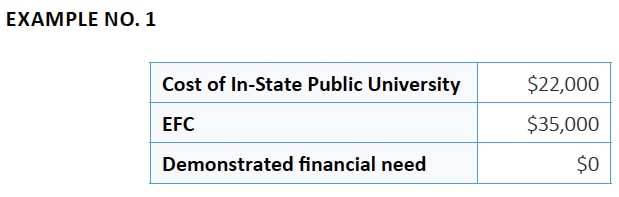
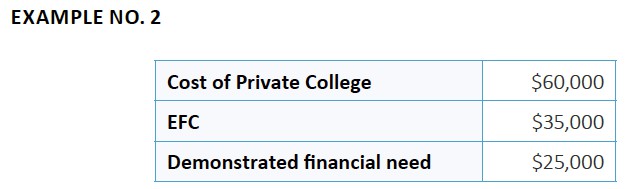
Determining if a student will be eligible for need-based aid requires subtracting the EFC from a school’s cost of attendance. The more expensive the school is, the more likely the student would qualify for financial assistance.
no 1
no. 2
In the first example, the student wouldn’t qualify for any need-based help because the family’s ability to pay exceeds the cost of the school. In the second scenario, however, the same student would be eligible for up to $25,000 in need-based aid from the private college because the price of this institution is far more expensive and exceeds the family’s EFC.

No. 3:

Families, who discover that they have a high EFC and aren’t eligible for need-based financial aid, should look for schools that provide merit scholarships that are given regardless of need. Most schools fall into this category.

No. 4:

If your EFC is modest, you should search for schools that provide excellent need-based assistance. Far fewer colleges and universities fit into this category.

No. 5:

Families with household incomes of $60,000 to $80,000 and above typically find that they do not qualify for need-based aid at state universities, but they may qualify for need-based aid at private schools.

No. 6:

Families will usually have to pay more for college than their EFC indicates they can afford because most schools do not meet 100% of a student’s demonstrated financial need. Consequently, it’s important to identify the most generous colleges and universities that would consider your child an attractive candidate.

No. 7:

It’s best to get a ballpark idea of what your Expected Family Contribution will be as early as your child’s freshman year in high school. Obtaining a preliminary EFC will give you a rough idea of the minimum amount that you will be expected to pay for college.

No. 8:

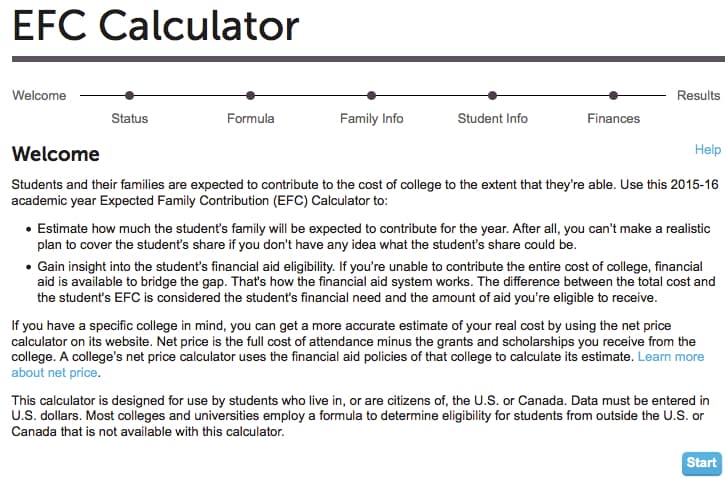
You can obtain your Expected Family Contribution by using the College Board’s EFC Calculator.  With this calculator, you’ll want to obtain your EFC using the federal and institutional formulas. Here is a screenshot of the calculator:
calculator
The calculator will produce an EFC using the federal methodology that is linked to the Free Application for Federal Student Aid.
The calculator will also produce an EFC using the institutional methodology, which is linked to the CSS/Financial Aid PROFILE, which is a product of the College Board. The vast majority of private and public colleges and universities only use the FAFSA while 260 mostly private, selective schools use the PROFILE.

No. 9:

When you complete the FAFSA, you will receive your official federal EFC via an electronic document called the Student Aid Report. The SAR will include the family’s Expected Family Contribution near the top of the report and also provide all the information that the family provided on the FAFSA. Parents should check for accuracy.

No. 10:

If you need to file the PROFILE, you will not receive your EFC from the College Board, which owns and operates this financial aid application. Institutions that use the PROFILE customize their aid applications by choosing from hundreds of different questions so you will end up with a different EFC for each school.

No. 11:

You should ask each PROFILE school for your EFC if the institutions do not include this important dollar figure on your financial aid awards.

No. 12:

Many schools fail to include a family’s EFC on their financial aid awards. Some institutions suggest that including the EFC on their aid letters will confuse families. More likely, schools don’t want to share EFC figures with families because parents would then be able to determine if the package is stingy.

No. 13:

Once you have your EFC and the financial aid package, compare your EFC with what a school is offering. Let’s say that the cost of a school after deducting institutional grants is $39,000 and your EFC is $28,000. That means there is an $11,000 gap between what your EFC suggests that you can pay and what the school wants to charge you.

No. 14:

Plug new numbers into the EFC calculator if your financial situation changes due to such things as a divorce, separation, death, disability, job loss or the care of an elderly parent.

No. 15:

Don’t be surprised if your EFC figures seem too high. The financial aid formulas as flawed and aren’t designed to accurately measure what you can actually afford to pay for college!

Saturday, April 25, 2015

Would You Pay $47,000 for the University of Oregon?

http://www.thecollegesolution.com/would-you-pay-47000-for-the-university-of-oregon/

Last week at the exercise boot camp that I attend on Sunday mornings, I saw a mom who hadn’t been coming to the workouts for several months. The mom is divorced and is trying to support herself as a manicurist.
Her son is a high school senior so I had been giving her some college advice before she stopped showing up on Sundays.
When I saw her, I asked her if her son knew where he would be attending school in the fall.
She frowned and said, “He wants to go to the University of Oregon.”
I was stunned. “Oregon! Are you kidding me?”
I was not optimistic when I asked, “Did he get any money from Oregon?”images-2
I wasn’t surprised when the mom said that her son’s package consisted entirely of loans for a school that will cost a nonresident at least $47,000.
The San Diegan teenager, who was attracted to Oregon because of its tremendous football success (!!!) is not dissuaded by the price tag.
Eighteen-year-olds seem immune to large price tags when loans can temporarily keep them from dealing with harsh financial realities. Making matters worse, the teachers at this teenager’s school are encouraging him to go to Oregon! Ryan’s dad is exploring how to make this work which would include a huge debt.

Universities Charge More When They Can

The steep price that Oregon is charging Ryan illustrates a classic supply-and-demand phenomenon. Public universities that are extremely popular with their own residents, as well as teenagers from other states, don’t have to offer much of a financial enticement (if any) to attract outsiders to their campuses. This same phenomenon is played out among private colleges and universities.
The Oregon flagship not only has a successful football program, but it is located next to the nation’s most populous state that doesn’t have enough capacity to educate its own college students. So many Californians are attending the U. of Oregon that it’s been called the University of California at Eugene.

Elite flagships are recruiting high-income students

university of michigan xx
U. of Michigan
When students contemplate the possibility of attending college outside their own state, they often put prominent state flagships on their dream lists. A major reason for this is because the typical teenagers and their parents unfortunately know of very few colleges and universities.
If you aren’t rich, however, I’d suggest that you not fall in love with name brand schools like the Universities of California, Michigan, Virginia, Texas or that are located in desirable geographic areas such as the University of Colorado and University of Vermont (both near mountains) and the University of Arizona and Arizona State (both temperate weather).
These schools and others with strong brand names are hungry for outsiders who can bankroll an education that can cost more than $200,000.
Some of these institutions, such as Michigan, provide token merit scholarships –  $5,742 is the average – but that won’t go far when you will be paying private school prices for state educations. Some prominent state universities, such as UCLA, UC Berkeley, UC San Diego, don’t  award any merit scholarships to outsiders.

Getting Into a Flagship

It’s easier to gain admission into prestigious flagships as an outsider now because these institutions need the extra cash. Finding out-of-state sugar daddies is one way for these schools to attract new dollars. And it’s easier to entice rich students to their campuses than for these institutions to get serious about making meaningful structural changes.
I wrote a story for my college blog over at CBS MoneyWatch a few years ago about a dad, who works at Columbia University, whose daughter had planned to attend the University of Michigan. She attended the new student orientation in the summer before her dad noticed that he had misread the bill. He thought the tuition was going to be a total of $19,000, but that was the price per semester. Now the school’s tuition is $4,000 a year more.
Affluent students are the ones attending these popular schools because state universities almost never give need-based aid to nonresident applicants who can’t afford the tab. And that’s why I never would have recommended that Ryan apply to Oregon. The most he could have hoped for would have been a token scholarship and that would have barely made a dent in the cost.
As these flagships attract more higher-income students within their own borders and beyond, low and middle-income residents are getting less access to these institutions. In essence, these mighty institutions are becoming privatized.

State Schools Off the Radar

Unless you can afford to pay private-school prices for an education at a public university, I would suggest throwing a much wider net. If you look beyond the most popular flagships, plenty of state universities offer significant discounts to nonresidents.
The New York state universities (SUNY’s) , for instance, represent some excellent values. Unlike many states, New York state has continued to support its public universities at levels other state legislatures have long abandoned.
Another potential great buy is the University of Minnesota in Minneapolis, which is a bargain compared to Michigan. I once asked a teenager why he thought that the University of Michigan is so much more popular than the U. of Minnesota, which is located in the Twin Cities. “Minnesota is cold,” he replied. I mentioned that Michigan is hardly a temperate climate. My theory is that Michigan has enjoyed a long and storied tradition of success in the Big 10 athletic conference and the Minnesota Gophers have not.
University of Utah
University of Utah
The scholarships for nonresidents can be more generous and prices much lower to begin with at schools that have to work harder to attract nonresidents. University of Arkansas, for instance, has tons of scholarships for nonresidents. A huge plus at Arkansas is the tremendous amount of internships for students because of Walmart’s proximity. Walmart requires major corporations to maintain an office in Arkansas so there are hundreds of corporate outposts in the state.
The University of New Mexico has impressive scholarships even for students with a 3.0 GPA and it’s located in a city (Albuquerque.) I am hoping that a daughter of a family friend, who is a gifted dancer, ends up at the University of Utah’s modern dance program, which is considered as good, if not better, than Julliard’s.
I could go on and on about the opportunities at state universities beyond the popular ones, but I think you get the picture.

Bottom Line: 

If you want to lock in better prices, you need to be more imaginative when looking for schools. You can’t continue to fish in the same pond as everyone else!

Thursday, April 9, 2015

College Admissions: 5 Admission Factors You Can’t Predict

 http://www.golocalprov.com/lifestyle/college-admissions-5-admission-factors-you-cant-predict

As the last few colleges release admission decisions this week, many families are puzzled by outcomes. Their child had GPA and SAT/ACT scores that fell within range for a specific college, participated in an array of extra-curricular activities, and spent hours perfecting applications and essays. Still, he/she was rejected from their top choice college while another seemingly similar student was accepted the very same school. What happened?
The reality is that college decisions are predictable in some ways, but unpredictable in others. A certain GPA and SAT/ACT scores won’t guarantee a student admission anywhere. There are several criteria that parents and counselors simply can’t factor, and they can affect decisions immensely.
  • The geographic, ethnic and gender mix that the college is seeking. Many colleges are striving to increase the number of minority and first generation students they enroll. Some schools are struggling to keep a balance of male and female enrollees (since women are going to college in higher numbers and men are dropping out more frequently). Additionally, colleges always like to have students on campus representing a wide variety of states and countries. In the last few years, we have seen Ivy League universities launch massive marketing campaigns to attract inner city, low income students. Some colleges, like College of Charleston, are pushing to enroll more young men to balance the male: female ratio. And the long running joke among elite northeastern colleges is that South Dakota is the best state to hail from, if you want a geographic advantage in admissions.
  • Teacher and guidance counselor recommendations. While we all would like to think our child is adored by teachers and administrators, not all are. Certainly, we hope that teachers and counselors would not say anything negative about a student in their recommendation, but they sometimes do. It’s not common, but I have seen situations in which both top ranked and struggling students have been thrown under the admissions bus by a negative recommendation that was completely unexpected. More often, the recommender uses lackluster adjectives or certain code words that can trigger concerns with an admissions committee. In some cases, teachers and counselors send in form recommendations that a particular college sees over and over again. And sadly, they just can’t stack up against an effusive letter of praise by a teacher who espouses the student’s true, individual attributes. 
  • What admissions officers want to see in student applications. Since admissions committee members vary from year to year, and a college’s values can shift, there is no predicting what will attract their attention on decision day. One year, the college may desperately be seeking French horn players, and the next they may place a high value on leadership roles in a community service organization. One admissions rep may connect with an essay that a student wrote on his/her sister with Autism. Another may be drawn to the detailed scientific explanation by the student who re-engineered his/her car computer system. Still another reader may gravitate toward a student who sees the lighter side of life through the eyes of a puppet they manipulate in a children’s theatre. There is no crystal ball for these sorts of situations.
  • The applicant pool for various majors. It goes without saying that the competition in science and business majors is often fierce among elite university candidates. However, some schools pay more attention than others when they are considering the major (or undeclared status) you selected on your application. Some may be seeking classics majors one year to keep the doors open on that department. Other years, the number of psychology or political science majors may be overwhelming. Engineering schools may want more female candidates, and education departments may want more men. In other cases, colleges may not really care what major you applied under; they feel students switch majors and the pools in each department will balance out in the end.
  • How an interviewer perceived the student. Not all colleges offer interviews, and even those that do may not use them in the admissions decision. For those that do: some 17 year olds have the social skills and intellectual savvy to ace the interview, others aren’t there yet. A student and interviewer may simply not “click." And, there are times when the admissions rep or alumni interviewer may simply feel that the candidate is not the right fit culturally or academically for the institution. You really have no way of knowing what was written about the student when he/she left the interview.
It’s often difficult to fathom why one student is accepted to a college and another is denied admission. The sharp pain of rejection can be brutal for students and parents. However, it’s critical to remember that there are a multitude of great schools in the U.S., and a student’s success is not predicated on attending one particular school. After all, less than 10% of Fortune 500 CEO’s went to an Ivy League college, and the doors to success are indeed open to students from all colleges.

Monday, March 9, 2015

Does It Matter Which College Your Child Chooses? Probably Not.

Between now and April 1, parents of high school seniors will be eagerly trolling their mailboxes, hoping to spot fat, cheer-worthy college acceptance envelopes. We long to see proof that everything our kids have done so far is paying off: Sports practices! Theater rehearsals! Debate teams! Chess clubs and robotics!
Alternatively, we’re seized by anxiety at the sight of those slender envelopes containing rejection letters saying our kids didn’t make the cut. Those letters tempt us to feel like our kids are failures and we are, too.
It’s natural that we feel this way, I suppose. After all, we know the college admissions process is competitive because the colleges keep telling us so, in all of their glossy literature trumpeting their supposedly unique features, like “hands-on learning,” “cutting-edge facilities,” and “award-winning faculty.” College enrollment jumped 32 percent between 2001 and 2011, with the number of full-time college students rising 38 percent, according to the National Center for Education Statistics.
Childhood isn’t meant to be a race to the college finish line. It’s meant to be a formative part of life. So is college.
As someone who is both a veteran of the college application process — I’m playing the waiting game with our youngest of five at the moment — and as a freelancer who writes college admissions materials, I wish I could give every parent of a high school senior a chill pill.  I want them to know what I do: that where your child ends up at college will probably matter a lot less than you think it will.
Sure, it’s nice to get a tony degree from an Ivy, if only for the bragging rights. Or from a school with deep endowment pockets so you don’t have to break the bank. But the reality is that there are about 5000 colleges and universities in this country and nearly every one of them has lots to offer.
In my work, I’m often asked to interview administrators, faculty members and students to determine how to put that school’s best foot forward. Inevitably, I find what I’m looking for: passionate professors; study abroad opportunities; career counseling; caring coaches; and top-notch kids who not only do well academically, but go out and do good in the world. Oh, and lately I’m seeing campus fitness facilities, housing and dining halls that rival world-class hotels.
Yep. Every college, from the smallest under-the-radar school to the biggest university, has cool things for your kid to learn, eat and enjoy.
“You must be so nervous,” a friend said recently. When I looked puzzled, she added, “About where your son’s going to get into school.”
Um, no. Not really. I don’t care where he ends up. What matters is that my son is happy and can continue following his passion for science and engineering as he makes new friends, maybe has a chance to run competitively and check out a few different jobs so he can keep honing his interests and applying what he learns in the classroom. My son will be happy and fulfilled at any of the colleges he applied to — despite the fact that his list of eight schools includes everything from one small city Ivy to one of the nation’s biggest rural state universities.
My son knows this, too. He has watched his brothers and sisters thrive, despite each of them taking a different educational and career path. Of our four, only one was admitted to his top choice: a small, New England independent college. (You know: brick buildings, liberal arts, lots of snow.) He graduated with an English degree and got a great job as a writer at a social media company. Having a degree helped him land the job, but not as much as the freelance writing he’d been doing for web sites while he was in school.
Our other son chose a medium-sized private college in Pennsylvania. He hated its rural location and transferred sophomore year to a city college. His biggest passion in life has always been movies;  he majored in film studies and went to Hollywood after graduation, where he’s now a set designer and art director. Is he successful because of his film studies degree? Partly. But he got his foot in the door because he had spent summers working with a carpenter and knew one end of a hammer from another. Being able to actually build sets meant he could work on them and meet people who gave him a leg up.
Our oldest daughter wasn’t admitted to her first choice college — an Ivy — so she ultimately decided to grit her teeth and attend a state university to save money. She hated it at first, then found her niche in the natural resources college. She got a job immediately after graduation with an environmental engineering company in California and is now in graduate school in Oregon, studying forestry.
Our other daughter wanted to study in Paris, but transferred to a women’s college two years later in search of more competitive academics. After graduating with high honors, she needed a break from academics and worked as a waitress, saving up enough to travel through Brazil. Now she’s happily working in a yoga sanctuary.
It’s a parent’s dream come true to have kids who not only make it through college, but then support themselves doing jobs they love. This dream is achievable no matter where your child goes to school.
It’s a parent’s dream come true to have kids who not only make it through college, but then support themselves doing jobs they love. This dream is achievable no matter where your child goes to school. What matters more than any academic pedigree is that your children pursue their passions outside the classroom — through field work, freelance writing, summer jobs, internships, study abroad programs — and accumulate the necessary skills and direction to pursue careers that engage and fulfill them.
Everything your child has done for the first 17 years of life — from playing tag to National Honor Society, from ballet lessons to video games — has been important simply for the experiences themselves. Childhood isn’t meant to be a race to the college finish line. It’s meant to be a formative part of life. So is college.
Your child will get into one of those schools you’re waiting to hear from. And, if the school turns out to be a bad fit, it’s not tough to transfer. Whatever institution your child ultimately graduates from, what you must hope for is that the education isn’t only about academics or athletics, Greek life or community service, but about educating the whole person in a way that inspires lifelong learning.

Thursday, March 5, 2015

College Touring Tips

Reposted from: http://www.paloaltoonline.com/blogs/p/2015/02/22/college-touring-tips

Spring and summer breaks are wonderful times to visit college campuses. If you are planning college tours with your future college students, here are some tips to help make the visits successful. 

Prior to visiting a campus, schedule an appointment. Most campuses offer tours twice a day. Weekend tours are very rare. Usually included in campus tours are an information session with a college admissions officer in which you can ask the hard questions such as admissions statistics, tips on what to include on the application, STEM programs for females and very specific questions regarding campus safety. Also by attending the information sessions, you will demonstrate to the office of admissions that a student is seriously interested in that campus. Colleges track these visits and it could make a difference in admissions. The student led tour of the campus gives prospective students an insider's look at life on campus – dorms, dining commons, classrooms, and the library, to name a few. Some campus tours are booked months in advance but you are always welcome to take a self-guided tour. The downside to self-guided tours is you don't get the admissions information session and you may not have the opportunity to see dorms or classrooms. However, it is easy to engage with college students hanging out on campus and ask them the questions about their experience. 

Depending on the academic and social preferences of the tour guide and the prospective student, there might not be a connection. Try not to let the perception of the campus be influenced by the tour guide; it's only one person and one perception. The good news is with social media, prospective students can log on and chat virtually with current students and inquire about their majors or clubs and activities from campuses to get a flavor of the respective campus. Students who have a clear interest in a particular department can always get in touch with the chair of the department and schedule a conversation and perhaps even discuss with current students in the department. 

When you ask tour guides why they chose their campus, you probably won't get an 
entertaining response
 like these Yale students put together, but you will learn about how they made their decision. 

Another consideration is WHEN you visit a campus. If it is during finals week, spring or winter break or on the weekend, the campus might not have the same "vibe" as it does when fully in session. I've visited large CSU campuses on weekends when there are literally only a handful of students walking around, not to mention that most of the buildings were closed. During the week, you are happily dodging pedestrians, bikes, and skateboards!

Did you know community colleges even offer campus tours? You can register online to take such a tour. For example, Foothill Community College offers tours that last about 45 minutes. They also offer self-guided tours. For more information, visit their website

For students who do not have the time or financial means to visit every college on their prospective list, virtual tours are the next best thing. Two websites many of my former students have found helpful are College Week Live and Campus Tours. Many of the colleges will visit local high schools (inquire with your high school for more details) and NACAC offers a spring college fair in the Bay Area. These options allow students to demonstrate interest and meet admissions officers without having to travel to their respective college campus. 

I would also recommend visiting colleges AFTER you have been admitted if your budget doesn't afford costly travel expenses. Keep the physical college tours for the short list. Some colleges will offer fly-in programs for low income students. Typically, the college covers housing and meals and the family covers travel expenses. Inquire at your colleges to learn more about this possibility and to determine if you are eligible to apply. Alternatively, visit local campuses that have similar personalities such as the campus size, the setting—city vs. suburbs, the same or equivalent academic programs, the opportunities for financial aid, etc. That way students at the very least can get a feel for what a campus with 6,000 students versus 35,000 looks like. The size of a campus and whether it is in a city or a small town are features that can be found in any state across the country. Even if local campuses are not an exact match, they will at least provide perspective.

Here are some questions commonly addressed during college tours and informational sessions:

Admissions Information Session 
What are your graduation/retention rates? 
How many students applied/accepted last year?
Parents should ask what the process is if their daughter/son is a victim of a sexual assault/physical assault/bullying by a fellow student, and also what safeguards are in place to protect the accused student from being unfairly treated.

Majors/Academics
Ask specific questions in the area(s) you are interested in.
What is the faculty to student classroom ratio?
Does the campus offer research programs for undergraduates? 
Are the classes taught by professors or teaching assistants? 
What is the average amount of time students study outside of the classroom? 
What is the grading system like (curve, A-F, evaluation based, etc.)
If your campus is religiously affiliated, you will want to find out what those requirements are.
What career opportunities does this major offer and how successful have former students been in finding an agreeable, well-paying position?

Housing 
If they can't show you a dorm, ask very specific questions.
How many students to a room?
Are there co-ed buildings or same sex floors?
Does the campus offer themed floors/dorms, etc.? 
How many students live on campus and how many commute? 
What are the housing requirements (some campuses require you to live on campus two years)? 
Are freshman allowed to have cars on campus (this is a popular question)?
What does the college do if my roommate and I are not getting along?

Financial Aid (if this is applicable) 
How many students receive Fin Aid? 
What is the average Fin Aid package? 
Are there merit-based scholarships? 
Does the campus offer work-study jobs?
Will the Fin Aid office work with me on payment plans?

Campus culture
If there is a club/activity you are particularly interested in, ask questions
What is the campus culture like? 
What type of clubs/organizations are offered? 
What do students do on the weekends? Specifically if you are at a campus where students tend to go home, you want to make sure you have a built-in community; otherwise, you are on campus bored and alone on weekends. 
What kind of activities are available off campus? 
What types of Arts and Cultural events are offered on campus or in the surrounding community?
If your campus is religiously affiliated, you can clarify is attending a religious service (i.e., mass or chapel) is mandatory or optional. 
Are there social and support programs available for first-generation students?

Greek Life 
How many students participate in Greek life?
How many fraternities and sororities are offered on campus?
What is the time commitment to be involved in a fraternity or sorority?
What is the pledge process like?

Weather - this especially plays a critical factor in decision-making for students moving to a dramatically different climate. 
Does the campus offer light therapy for students who suffer from depression?
How have students from (California, for example) adjusted to living in cold conditions (like New York or Boston)? 
What policies does the campus have for snow days?
What if any policies are in place for "natural disaster" situations? (Basically, how prepared is the campus for this kind of situation?). 

Dining
What is the food like? If you have a specific food requests (organic, locally sustained, vegan, gluten free, etc.) be sure there are enough options available to you.
What are the meal plans offered?
How many dining commons are provided on campus?
How are the dining establishments off campus?

Peer-to-Peer 
Your tour guides are current students. Ask them where they are from, what their major is and how they decided to attend this college. You can also ask them where else they applied or which other colleges were they accepted to. 

Campus Resources and Safety
What types of academic resources (counseling, tutoring, EOP/First Gen, etc.) are available to students?
What type of personal services (counseling, health and wellness) are available?
How safe is the campus?
How many incidents (crime, assault, etc.) are reported annually?

Be sure to allow enough time to walk around the surrounding areas of the campus. See if the neighborhoods are student-friendly (is there ample off-campus housing, safe bike routes, laundry, grocery stores, etc.). Visit a local coffee house or eatery to get a feel for the community culture and compare that to the campus culture. And, most important, students need to ask themselves if they can live, learn, and become an integral part of that college's community for the next 4-6 years.