Showing posts with label financial aid. Show all posts

Wednesday, January 6, 2016

It is National Scholarship Month, which means high school seniors are being exhorted to scoop up free money for college.
What they are often not told is that scholarships won from corporations, nonprofits and other “outside” sources can reduce — dollar for dollar — the grants and cost-reducing financial aid they might get from colleges.
Students with financial need should be aware of this potential disincentive before they spend countless hours pursuing scholarships that may leave them no better off. The same scholarships could, however, benefit affluent families by reducing the amount they have to pay or borrow.
Casey Lu Simon-Plumb, a sophomore at Swarthmore College in Pennsylvania, won more than a dozen scholarships during her senior year of high school, including a $20,000 Coca-Cola Scholars Foundation award.
She thought her winnings would dramatically reduce the $60,000 annual cost of attending the school.
Instead, the outside money replaced other aid Swarthmore had offered her, leaving her family’s contribution about the same.
Federal rules require schools to reduce need-based financial aid when students win outside scholarships to ensure that their total financial aid does not exceed their costs by more than $300.

Thursday, December 17, 2015

Understanding the 2 Types of College Financial Aid

My family and I just returned from Charlotte, North Carolina, where my two boys competed in and won their first Jiu-Jitsu tournament.  On the ride home, one asked if he could get a college scholarship if he continued to win tournaments.
That reminded me how important financial aid is for most families. Almost all parents can benefit from understanding their options before their children apply.
Let’s explore the two different types of financial aid.


Read more: http://www.nasdaq.com/article/understanding-the-2-types-of-college-financial-aid-cm546836#ixzz3sznVfBT3

Saturday, December 12, 2015

How Divorce and Separation Can Affect Financial Aid

When students apply to college, there are many forms to complete. And if they are applying for financial aid, the FAFSA is No. 1 on the list. This form asks the obvious questions: name, date of birth, Social Security number, address etc. It also asks questions about parents’ financial information to determine financial aid eligibility.

If you are separated or divorced, this part of the FAFSA raises many questions:

    • How will colleges treat the income of two separate families?
    • Which parent’s income is used for determining the expected family contribution, or EFC?
    • Do both parents have to report their incomes?
    • What do the words “custodial parent” mean?

Sunday, November 1, 2015

FAFSA filing dates are changing, beginning with the 2017-2018 academic year, and that could affect parents' finances Now that college application season has begun, it’s time for students and families to consider college costs and how they’re going to pay them. The key to college financing is the FAFSA, the Free Application for Federal Student Aid, which every school, both public and private, uses to calculate how much aid is available for a particular student and which all government student loans — for students and parents — require before dispensing any funds. “Everyone should complete the FAFSA,” Mark Kantrowitz, Publisher of Edvisors.com, a website offering advice on planning and paying for college, and author of six books on the topic. Even returning students who didn’t get any financial aid the previous year should complete the FAFSA, says Kantrowitz, explaining that changes in student assets or parents’ income could impact the amount and type of financial aid available. “You can’t get money if you don’t apply, so always apply,” says Kantrowitz. “Even if you don’t qualify for aid, FAFSA is a prerequisite for unsubsidized federal Stafford loans and federal PLUS loans, which are available without regard to financial aid.” (Related: 15 Best Paying Jobs for College Business Majors: 2015) In a far-ranging webinar on “Filing the FAFSA,” Kantrowitz laid out some tips on filing the FAFSA and updates on changes that students, their families and financial advisors should be aware of: File the FAFSA ASAP. 1. File the FAFSA ASAP. This year, that means as close to Jan. 1 as possible – the first date the latest FAFSA will be available. Even if you don’t know where your child will be going to college and haven’t filed your tax return for the previous year, file early, says Kantrowitz. “The earlier you file the FAFSA the better off you will be,” he said. You can update the income data after your income tax form is filed. There are several reasons to file sooner than later, all related to the early bird getting the worm. “Nine states offer aid on a first come, first serve basis until the money runs out, three states have February deadlines, and 11 states have March deadlines,” Kantrowitz explained. In addition, he noted, colleges get a fixed allocation for federal supplement education opportunity grants and federal work study. “When the money runs out, there’s no more.” And some colleges have two deadlines for financial aid – a preferred deadline and regular deadline. File by the preferred deadline because more money will be available then. “Students who file the FAFSA in January, February and March tend to receive more than twice as much grant dollars as on average as students who file later, and they get more money the earlier they file, in January instead of February, in February instead of March, etc.” said Kantrowitz. The final deadline is June 30. File Two FAFSAs in 2016 2. File two FAFSAs in 2016. The federal government has changed the starting date for filing the FAFSA beginning with the 2017-2018 academic year, moving it back from January 1 to October 1 of the previous year. In 2016, then, families can file the FAFSA for the 2016-2017 academic year as early as January 1 and the FAFSA for the 2017-2018 academic year as early as October 1. The earlier October 1 start date reflects a change in the base tax year used in future FAFSA filings. Instead of reporting the previous year’s income on the FAFSA, families will report the income from two years ago starting with the 2017-2018 academic year. They will no longer need to update their filing with the actual data from their tax return because they will be using a tax return that has already been filed. That has implications for how parents handle their finances. Adjust income for the new, earlier FAFSA filing date 3. Adjust income for the new, earlier FAFSA filing date. Since FAFSA will look back two years instead of one, parents of high school juniors this year should try to minimize the income they report on their tax return. “Offset capital gains with losses or don’t realize any more gains that you can offset with losses,” Kantrowitz advises. “In the future don’t make changes during [your kid’s] junior year but in the sophomore year of high school” because of the new income reporting lookback. Kantrowitz also advises parents to pay down debt, maximize retirement plan contributions, defer income and retirement distributions until after your student graduates — whatever can be done to reduce reportable assets. And he warns against setting up trust funds to reduce reportable income. “Trust funds mostly backfire even if they include restricted access to principal,” says Kantrowitz. Use the IRS Retrieval Tool to report income 4. Use the IRS Retrieval Tool to report income. Not only does this save time but it also reduces the odds of delays because the numbers won’t be subject to verification, says Kantrowitz. In the meantime for the upcoming 2016-2017 academic year he advises that parents estimate income using their latest tax return filed or 2015 pay stubs, then update that data with the IRS Retrieval Tool after the 2015 tax return is filed. Get an FSA ID 5. Get an FSA ID. Before parents or students can file a FAFSA they need a Federal Student Aid ID, which can be obtained at the fsaid.ed.gov website. This ID replaces the PINs that students and parents used previously because it is not tied to Social Security numbers, birthdates and other personal data and therefore considered more electronically secure. Double-check everything. 6. Double-check everything. “Nothing will delay a FAFSA faster than errors or omissions,” says Kantrowitz. Use legal names for parents and students, check social security numbers, addresses, etc. And note that every reference to “I” or “You” refers to the students, not the parents or FAFSA preparer, if one is used. File the FAFSA Electronically 7. File the FAFSA electronically. This allows parents and students to receive results in a few days which will include the Expected Family Contribution that schools base financial aid on and that government loans require. The FAFSA can be sent to a maximum 10 schools; after that, schools can be switched out with more names. Starting in the 2016-2017 academic year, FAFSA will not share the list of colleges on a student’s FAFSA with other colleges they have applied to. That could help students qualify for admission and financial aid because some colleges have used the list of students’ preferred schools when considering their applications. Since some college ratings lists consider the percentage of accepted students who then enroll, a college was more likely to turn down a student who ranked it a low priority. --- Related on ThinkAdvisor: 15 Best Paying Jobs for College Business Majors: 2015 30 Best Paying College Majors: 2015 15 Cheapest Colleges With Best Job Value Top 13 Colleges Whose Grads Earn the Most: 2015 Close single page viewReprintsDiscuss this story Bernice Napach By Bernice Napach Senior Writer ThinkAdvisor @Think_Napach Share this story

Posted from: http://www.thinkadvisor.com/2015/10/25/college-planning-7-steps-to-filing-the-fafsa?page_all=1


FAFSA filing dates are changing, beginning with the 2017-2018 academic year, and that could affect parents' finances

Now that college application season has begun, it’s time for students and families to consider college costs and how they’re going to pay them. The key to college financing is the FAFSA, the Free Application for Federal Student Aid, which every school, both public and private, uses to calculate how much aid is available for a particular student and which all government student loans — for students and parents — require before dispensing any funds.
“Everyone should complete the FAFSA,” Mark Kantrowitz, Publisher of Edvisors.com, a website offering advice on planning and paying for college, and author of six books on the topic. Even returning students who didn’t get any financial aid the previous year should complete the FAFSA, says Kantrowitz, explaining that changes in student assets or parents’ income could impact the amount and type of financial aid available.
“You can’t get money if you don’t apply, so always apply,” says Kantrowitz. “Even if you don’t qualify for aid, FAFSA is a prerequisite for unsubsidized federal Stafford loans and federal PLUS loans, which are available without regard to financial aid.”
In a far-ranging webinar on “Filing the FAFSA,” Kantrowitz laid out some tips on filing the FAFSA and updates on changes that students, their families and financial advisors should be aware of:
File the FAFSA ASAP.
1. File the FAFSA ASAP. This year, that means as close to Jan. 1 as possible – the first date the latest FAFSA will be available. Even if you don’t know where your child will be going to college and haven’t filed your tax return for the previous year, file early, says Kantrowitz. “The earlier you file the FAFSA the better off you will be,” he said. You can update the income data after your income tax form is filed.
There are several reasons to file sooner than later, all related to the early bird getting the worm. “Nine states offer aid on a first come, first serve basis until the money runs out, three states have February deadlines, and 11 states have March deadlines,” Kantrowitz explained. In addition, he noted, colleges get a fixed allocation for federal supplement education opportunity grants and federal work study. “When the money runs out, there’s no more.” And some colleges have two deadlines for financial aid – a preferred deadline and regular deadline. File by the preferred deadline because more money will be available then.
“Students who file the FAFSA in January, February and March tend to receive more than twice as much grant dollars as on average as students who file later, and they get more money the earlier they file, in January instead of February, in February instead of March, etc.” said Kantrowitz. The final deadline is June 30.
File Two FAFSAs in 2016
2. File two FAFSAs in 2016. The federal government has changed the starting date for filing the FAFSA  beginning with the 2017-2018 academic year, moving it back from January 1 to October 1 of the previous year. In 2016, then, families can file the FAFSA for the 2016-2017 academic year as early as January 1 and the FAFSA for the 2017-2018 academic year as early as October 1.
The earlier October 1 start date reflects a change in the base tax year used in future FAFSA filings. Instead of reporting the previous year’s income on the FAFSA, families will report the income from two years ago starting with the 2017-2018 academic year. They will no longer need to update their filing with the actual data from their tax return because they will be using a tax return that has already been filed. That has implications for how parents handle their finances.
Adjust income for the new, earlier FAFSA filing date
3. Adjust income for the new, earlier FAFSA filing date.  Since FAFSA will look back two years instead of one, parents of high school juniors this year should try to minimize the income they report on their tax return. “Offset capital gains with losses or don’t realize any more gains that you can offset with losses,” Kantrowitz advises. “In the future don’t make changes during [your kid’s] junior year but in the sophomore year of high school” because of the new income reporting lookback.
Kantrowitz also advises parents to pay down debt, maximize retirement plan contributions, defer income and retirement distributions until after your student graduates — whatever can be done to reduce reportable assets. And he warns against setting up trust funds to reduce reportable income. “Trust funds mostly backfire even if they include restricted access to principal,” says Kantrowitz.
Use the IRS Retrieval Tool to report income
4. Use the IRS Retrieval Tool to report income.  Not only does this save time but it also reduces the odds of delays because the numbers won’t be subject to verification, says Kantrowitz. In the meantime for the upcoming 2016-2017 academic year he advises that parents estimate income using their latest tax return filed or 2015 pay stubs, then update that data with the IRS Retrieval Tool after the 2015 tax return is filed.
Get an FSA ID
5. Get an FSA ID. Before parents or students can file a FAFSA they need a Federal Student Aid ID, which can be obtained at the fsaid.ed.gov website. This ID replaces the PINs that students and parents used previously because it is not tied to Social Security numbers, birthdates and other personal data and therefore considered more electronically secure.
Double-check everything.
6. Double-check everything. “Nothing will delay a FAFSA faster than errors or omissions,” says Kantrowitz. Use legal names for parents and students, check social security numbers, addresses, etc. And note that every reference to “I” or “You” refers to the students, not the parents or FAFSA preparer, if one is used.
File the FAFSA Electronically
7. File the FAFSA electronically. This allows parents and students to receive results in a few days which will include the Expected Family Contribution that schools base financial aid on and that government loans require.
The FAFSA can be sent to a maximum 10 schools; after that, schools can be switched out with more names. Starting in the 2016-2017 academic year, FAFSA will not share the list of colleges on a student’s FAFSA with other colleges they have applied to. That could help students qualify for admission and financial aid because some colleges have used the list of students’ preferred schools when considering their applications. Since some college ratings lists consider the percentage of accepted students who then enroll, a college was more likely to turn down a student who ranked it a low priority.

Wednesday, June 17, 2015

How To Lose Your College Financial Aid

http://www.forbes.com/sites/nataliesportelli/2015/06/08/how-to-lose-your-college-financial-aid/3/

When deciding which college to attend, students consider factors such as academics, prestige, location, and size. Even though these features are all important when making a final decision, for money-conscious families, a financial aid package is often the deciding factor.
Although seeing the right number on paper can be exciting for students and parents alike, there are almost always strings attached to the award. Financial aid can help students afford college, but it is not free money and families may find that keeping those dollars from freshman to senior year is more difficult than they anticipated.
Financial Aid Fails
In the frenzy of reading acceptances and financial aid letters, families may not consider the conditions under which the money is being offered. “The requirement for maintaining eligibility, so you can continue receiving a financial aid award, is something people don’t pay attention to,” says Mark Kantrowitz, publisher of Edvisors.com and author of Filing the FAFSA.“Families don’t usually look at the award letter in too much detail and often the letters are really confusing.”
Once they get to college, students on financial aid can’t slack off or they could be out thousands of tuition dollars. “The number one way students lose aid is their grades,” says Kantrowitz. To remain eligible for federal and college financial aid, students typically have to maintain at least a C average and be making Satisfactory Academic Progress (SAP), which means that they are on track to receive their degree within a set time frame (3 years for an Associate’s degree and 6 years for a Bachelor’s degree).
Fall below a 2.0 GPA, and the aid can disappear. If students get their grades up, they may regain their aid, however this task may prove challenging. “It can be difficult to improve your grades when you’ve had some other reason to fail courses like illness, injury, and death of a relative,” says Kantrowitz.
Outside of the classroom, students must maintain a good record to keep their aid. “You cannot be convicted for sale or possession of illegal substances if you’re on federal aid because you can lose your eligibility.” Upon release, most eligibility limitations are removed, but if the charges were for a drug or sexual offense, access to aid could be limited.


When accepting a financial aid award, students and their parents may not consider the possibility of a worst case scenario and fail to look into the strings attached to their package. “Families may not pay attention to disclosures because they may not be in the financial aid packet, but they are always in the college course catalogue,” says Kantrowitz.

What’s Not In The Letter
Students and their families should be aware that the initial number they in their award letter is not guaranteed for all four years. Financial aid is awarded on a yearly basis so if circumstances change, financial aid will change. That means that aid can fluctuate based on what families report on the FAFSA. If parents make more money one year, they may see a decrease in their package. If they make less another, they may see more.
Financial need is determined by subtracting Expected Family Contribution (EFC) from Cost of Attendance (COA). But EFC is not actually a number. “It’s not a dollar amount, it’s an index of eligibility,” says Paul Wrubel, cofounder of TuitionCoach.com. “Colleges aren’t under a moral obligation to give you a specific amount of money.” That’s why, he says, financial aid offered at one college can be drastically different than at another, even though the FAFSA is identical. So, EFC can be very expensive speculation.
When first receiving notification of an award, families may not understand what kind of monetary support the school is actually offering. Colleges are free to adjust financial aid packages during matriculation, frontloading the grant money and then later reducing it and replacing it with loans. “When you accept an award and there is grant money involved, you should do whatever it takes get a letter saying that if a student progresses normally you should get that grant money every year,” says Wrubel. “If you don’t secure grant money then you’re just eligible for more student loans.” Students can be in danger of graduating with loans they didn’t know had if they do not clearly understand what kind of support the school is offering them.
Financial aid letters can also offer work study compensation as part of the package. However, that money has to be earned. Students get paid for hours logged during their work study and that is considered part of their EFC. If they do not work the set amount of time, they will not earn the total amount of work study compensation offered. Often, too, they may find these paychecks go towards personal expenses that arise, rather than their tuition bill.
When Financial Aid Doesn’t Work
Often, financial aid packages aren’t enough to cover all the costs of going to college. “Typically financial aid covers tuition and room and board, but sometimes miscellaneous expenses aren’t covered,” says Felicia Gopaul, a certified financial planner who started the College Funding Resource. “Things like transportation or a new computer are costs students and parents don’t necessary know about upfront.” These fees as well as extra charges for certain classes or printing are other add-ons that may arise.
Students should also be aware that they can amass interest on loans in their financial aid packages. If they don’t pay interest on their loans during school, it will go on their loan balance and they will have to pay the extra charges after graduation. “Most of the time students just ignore the interest on their loans because they can defer making payments on them while in school,” says Gopaul. “They don’t understand the impact it will have on their finances if they let interest accrue.”
On top of everything else, students may not be prepared for the personal and fiscal responsibility that comes with taking on loans associated with financial aid. “There is an inclination with some students to live beyond the student lifestyle because oftentimes they think of student loans as free money and sometimes take out more loans than they need,” says Gopaul. “They continue to live like mom and dad are supporting them and not necessarily understand that those are costs that they’re going to pay back.”
Although financial aid can support a student’s dream of attending college, it can also present a number of hurdles and make false promises of college’s true affordability. If they don’t do their research, students and their parents could be paying the price of their financial aid long after they receive a diploma.

Thursday, April 30, 2015

Your Crucial 1st Step Before Looking for Colleges

http://www.thecollegesolution.com/your-crucial-1st-step-before-looking-for-colleges/

If paying for college is going to be a challenge, and it usually is, it’s important that you obtain your Expected Family Contribution before your begin looking at colleges with your teenagers.
In fact, obtaining your EFC should be the FIRST STEP you take in the college process.
Here is a quick rundown of what an EFC is, why it’s important, how you can obtain this critical figure and what you should do after you’ve generated  it.

No. 1:

An Expected Family Contribution is a dollar figure that represents what financial aid formulas believe you should be able to pay for one year of a child’s college education.
Families with adjusted gross incomes of $24,000 have an automatic EFC of $0. The EFC for the average American household with an AGI of $55,000 will usually range from $5,000 to $6,000. There is no cap on EFCs so some wealthy families will have EFCs that exceed the cost of an expensive private university.

No. 2:

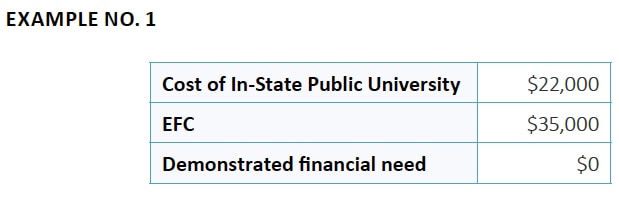
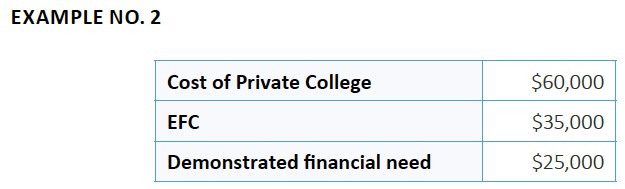
Determining if a student will be eligible for need-based aid requires subtracting the EFC from a school’s cost of attendance. The more expensive the school is, the more likely the student would qualify for financial assistance.
no 1
no. 2
In the first example, the student wouldn’t qualify for any need-based help because the family’s ability to pay exceeds the cost of the school. In the second scenario, however, the same student would be eligible for up to $25,000 in need-based aid from the private college because the price of this institution is far more expensive and exceeds the family’s EFC.

No. 3:

Families, who discover that they have a high EFC and aren’t eligible for need-based financial aid, should look for schools that provide merit scholarships that are given regardless of need. Most schools fall into this category.

No. 4:

If your EFC is modest, you should search for schools that provide excellent need-based assistance. Far fewer colleges and universities fit into this category.

No. 5:

Families with household incomes of $60,000 to $80,000 and above typically find that they do not qualify for need-based aid at state universities, but they may qualify for need-based aid at private schools.

No. 6:

Families will usually have to pay more for college than their EFC indicates they can afford because most schools do not meet 100% of a student’s demonstrated financial need. Consequently, it’s important to identify the most generous colleges and universities that would consider your child an attractive candidate.

No. 7:

It’s best to get a ballpark idea of what your Expected Family Contribution will be as early as your child’s freshman year in high school. Obtaining a preliminary EFC will give you a rough idea of the minimum amount that you will be expected to pay for college.

No. 8:

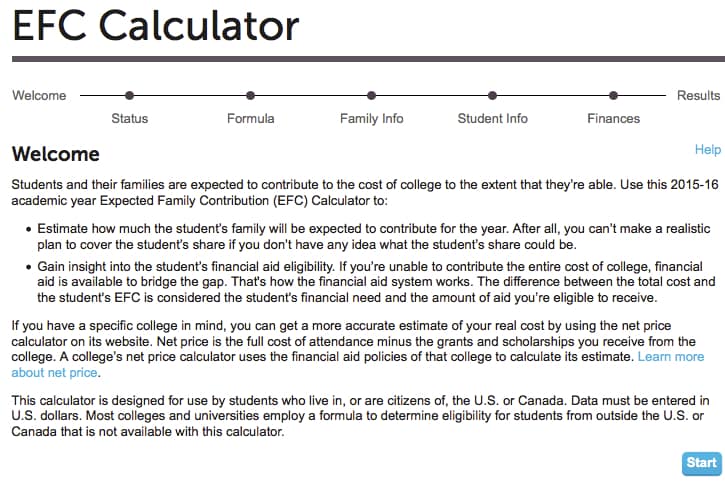
You can obtain your Expected Family Contribution by using the College Board’s EFC Calculator.  With this calculator, you’ll want to obtain your EFC using the federal and institutional formulas. Here is a screenshot of the calculator:
calculator
The calculator will produce an EFC using the federal methodology that is linked to the Free Application for Federal Student Aid.
The calculator will also produce an EFC using the institutional methodology, which is linked to the CSS/Financial Aid PROFILE, which is a product of the College Board. The vast majority of private and public colleges and universities only use the FAFSA while 260 mostly private, selective schools use the PROFILE.

No. 9:

When you complete the FAFSA, you will receive your official federal EFC via an electronic document called the Student Aid Report. The SAR will include the family’s Expected Family Contribution near the top of the report and also provide all the information that the family provided on the FAFSA. Parents should check for accuracy.

No. 10:

If you need to file the PROFILE, you will not receive your EFC from the College Board, which owns and operates this financial aid application. Institutions that use the PROFILE customize their aid applications by choosing from hundreds of different questions so you will end up with a different EFC for each school.

No. 11:

You should ask each PROFILE school for your EFC if the institutions do not include this important dollar figure on your financial aid awards.

No. 12:

Many schools fail to include a family’s EFC on their financial aid awards. Some institutions suggest that including the EFC on their aid letters will confuse families. More likely, schools don’t want to share EFC figures with families because parents would then be able to determine if the package is stingy.

No. 13:

Once you have your EFC and the financial aid package, compare your EFC with what a school is offering. Let’s say that the cost of a school after deducting institutional grants is $39,000 and your EFC is $28,000. That means there is an $11,000 gap between what your EFC suggests that you can pay and what the school wants to charge you.

No. 14:

Plug new numbers into the EFC calculator if your financial situation changes due to such things as a divorce, separation, death, disability, job loss or the care of an elderly parent.

No. 15:

Don’t be surprised if your EFC figures seem too high. The financial aid formulas as flawed and aren’t designed to accurately measure what you can actually afford to pay for college!

Monday, April 27, 2015

Countdown to College: 6 Tips to help make the final college decision

Just ask any family that is struggling with making the final college choice how envious they are of the families where it was a slam-dunk decision. It’s that time. A final college decision needs to be made and a deposit check needs to be received by May 1.
Here are some tips for families suffering through sleepless nights, pros and cons lists, self-doubt and the agony of indecision.
▪ Eliminate the colleges where the all-in price (tuition, room/board, expenses) makes you gasp loudly, where you just feel uncomfortable.
▪ Compare the financial aid packages of the remaining colleges on an apples-to-apples basis by creating a spreadsheet with the following headings: tuition, room, board and expenses (include travel and entertainment) equals Total Cost, and then grants and work-study with separate line items for subsidized loans and unsubsidized loans.
▪ Network socially. Join Facebook groups for admitted students, read reviews and/or chat with current students on College Confidential, speak to friends and neighbors who have children or relatives attending the colleges you’re considering.
▪ Compare the soft stuff. The emphasis on sports matters, whether the dining hall food is palatable matters, the culture of the campus and the surrounding area matters. Remember you’ll be living there four years.
▪ Evaluate the academics. Which companies are recruiting on campus? What is the grad school acceptance rate for your anticipated area of study? What is the depth and breadth of your major?
▪ Think beyond the workforce or grad school. Your college years should teach you how to think critically. Michael Roth, president of Wesleyan University in Middletown, Conn., and author of “Beyond the University: Why Liberal Education Matters,” says: “Your college education should prepare you to thrive by creating habits of mind and spirit that will continue to develop far beyond one’s university years. Thriving means realizing your capabilities, and a liberal education should enable you to discover capabilities you didn’t even know you had while deepening those that provide you with meaning and direction.”
He also share his thoughts on making the final decision, “Your college choice isn’t just about ‘fit’ and ‘comfort’; and it certainly shouldn’t be reduced to the prestige of the school or the amenities if offers.
“Your college choice should reflect your aspirations, where you can imagine yourself discovering more about the world and your capabilities to interact with it. The college you choose should be a place at which you can thrive, finding out so much more about yourself as you also discover how the world works, how to make meaning from it and how you might contribute to it.”
Bierer is an independent college adviser based in Charlotte. Send questions to: lee@collegeadmissionsstrategies.com; www.collegeadmissionsstrategies.com

Saturday, April 25, 2015

Would You Pay $47,000 for the University of Oregon?

http://www.thecollegesolution.com/would-you-pay-47000-for-the-university-of-oregon/

Last week at the exercise boot camp that I attend on Sunday mornings, I saw a mom who hadn’t been coming to the workouts for several months. The mom is divorced and is trying to support herself as a manicurist.
Her son is a high school senior so I had been giving her some college advice before she stopped showing up on Sundays.
When I saw her, I asked her if her son knew where he would be attending school in the fall.
She frowned and said, “He wants to go to the University of Oregon.”
I was stunned. “Oregon! Are you kidding me?”
I was not optimistic when I asked, “Did he get any money from Oregon?”images-2
I wasn’t surprised when the mom said that her son’s package consisted entirely of loans for a school that will cost a nonresident at least $47,000.
The San Diegan teenager, who was attracted to Oregon because of its tremendous football success (!!!) is not dissuaded by the price tag.
Eighteen-year-olds seem immune to large price tags when loans can temporarily keep them from dealing with harsh financial realities. Making matters worse, the teachers at this teenager’s school are encouraging him to go to Oregon! Ryan’s dad is exploring how to make this work which would include a huge debt.

Universities Charge More When They Can

The steep price that Oregon is charging Ryan illustrates a classic supply-and-demand phenomenon. Public universities that are extremely popular with their own residents, as well as teenagers from other states, don’t have to offer much of a financial enticement (if any) to attract outsiders to their campuses. This same phenomenon is played out among private colleges and universities.
The Oregon flagship not only has a successful football program, but it is located next to the nation’s most populous state that doesn’t have enough capacity to educate its own college students. So many Californians are attending the U. of Oregon that it’s been called the University of California at Eugene.

Elite flagships are recruiting high-income students

university of michigan xx
U. of Michigan
When students contemplate the possibility of attending college outside their own state, they often put prominent state flagships on their dream lists. A major reason for this is because the typical teenagers and their parents unfortunately know of very few colleges and universities.
If you aren’t rich, however, I’d suggest that you not fall in love with name brand schools like the Universities of California, Michigan, Virginia, Texas or that are located in desirable geographic areas such as the University of Colorado and University of Vermont (both near mountains) and the University of Arizona and Arizona State (both temperate weather).
These schools and others with strong brand names are hungry for outsiders who can bankroll an education that can cost more than $200,000.
Some of these institutions, such as Michigan, provide token merit scholarships –  $5,742 is the average – but that won’t go far when you will be paying private school prices for state educations. Some prominent state universities, such as UCLA, UC Berkeley, UC San Diego, don’t  award any merit scholarships to outsiders.

Getting Into a Flagship

It’s easier to gain admission into prestigious flagships as an outsider now because these institutions need the extra cash. Finding out-of-state sugar daddies is one way for these schools to attract new dollars. And it’s easier to entice rich students to their campuses than for these institutions to get serious about making meaningful structural changes.
I wrote a story for my college blog over at CBS MoneyWatch a few years ago about a dad, who works at Columbia University, whose daughter had planned to attend the University of Michigan. She attended the new student orientation in the summer before her dad noticed that he had misread the bill. He thought the tuition was going to be a total of $19,000, but that was the price per semester. Now the school’s tuition is $4,000 a year more.
Affluent students are the ones attending these popular schools because state universities almost never give need-based aid to nonresident applicants who can’t afford the tab. And that’s why I never would have recommended that Ryan apply to Oregon. The most he could have hoped for would have been a token scholarship and that would have barely made a dent in the cost.
As these flagships attract more higher-income students within their own borders and beyond, low and middle-income residents are getting less access to these institutions. In essence, these mighty institutions are becoming privatized.

State Schools Off the Radar

Unless you can afford to pay private-school prices for an education at a public university, I would suggest throwing a much wider net. If you look beyond the most popular flagships, plenty of state universities offer significant discounts to nonresidents.
The New York state universities (SUNY’s) , for instance, represent some excellent values. Unlike many states, New York state has continued to support its public universities at levels other state legislatures have long abandoned.
Another potential great buy is the University of Minnesota in Minneapolis, which is a bargain compared to Michigan. I once asked a teenager why he thought that the University of Michigan is so much more popular than the U. of Minnesota, which is located in the Twin Cities. “Minnesota is cold,” he replied. I mentioned that Michigan is hardly a temperate climate. My theory is that Michigan has enjoyed a long and storied tradition of success in the Big 10 athletic conference and the Minnesota Gophers have not.
University of Utah
University of Utah
The scholarships for nonresidents can be more generous and prices much lower to begin with at schools that have to work harder to attract nonresidents. University of Arkansas, for instance, has tons of scholarships for nonresidents. A huge plus at Arkansas is the tremendous amount of internships for students because of Walmart’s proximity. Walmart requires major corporations to maintain an office in Arkansas so there are hundreds of corporate outposts in the state.
The University of New Mexico has impressive scholarships even for students with a 3.0 GPA and it’s located in a city (Albuquerque.) I am hoping that a daughter of a family friend, who is a gifted dancer, ends up at the University of Utah’s modern dance program, which is considered as good, if not better, than Julliard’s.
I could go on and on about the opportunities at state universities beyond the popular ones, but I think you get the picture.

Bottom Line: 

If you want to lock in better prices, you need to be more imaginative when looking for schools. You can’t continue to fish in the same pond as everyone else!

Saturday, February 28, 2015

6 tips for deciphering a financial aid letter

Reposted from: http://www.cbsnews.com/news/6-tips-for-how-to-decipher-a-financial-aid-letter/
For high school seniors, the agonizing college admission process is almost over. All that's left for many students is deciding which college they can afford.
Answering this question, however, isn't as easy as it might seem because it requires deciphering financial aid letters. Unfortunately, many colleges and universities send out financial aid letters that are difficult to understand.
So, here are six tips to help you make sense of any financial aid award.
1. Know what should be in every financial aid award.
Award letters should reflect the full cost of attendance. A financial aid letter should include tuition, room/board, textbooks, travel and miscellaneous expenses. The cost of the school, minus any grants/scholarships, will generate your net cost.
"For purposes of comparison, it is important to see how much grant assistance you are being offered and what the net price is," advised Joseph Bagnoli Jr., dean of admission and financial aid at Grinnell College in Iowa.
2. Check for this key figure.
Sometimes what a school fails to include in a financial aid letter creates problems for families.
Few award letters, for instance, include an extremely important figure: the Expected Family Contribution (EFC). This dollar figure tells a family what the financial aid formula has determined the household should be able to pay for one year of college. Without this critical figure in the award letter, it would be impossible to know if a student's package is a good one or not.
For example, let's suppose a family's EFC is $20,000, but the school's cost is $55,000. Ideally, the student would get $35,000 in financial assistance to bridge this gap, and most of that would be in the form of grants and scholarships.
In this hypothetical case, however, the student only received a $10,000 merit award and a federal loan. The $10,000 award wouldn't make a significant dent in the family's demonstrated need for $35,000 in assistance. Without knowing their EFC, the parent and students may not understand that this is a poor award.
If the school does not include the EFC on the award letter, contact the financial aid office and ask what this figure is.
3. Make sure loans are clearly marked.
Some schools' award letters make it difficult to differentiate between loans and grants/scholarships. I've seen letters where the federal student loan has been referred to as "a Stafford" rather than "a federal Stafford Loan." Inserting loans in a package without properly identifying them will make a school look less expensive than it really is.
4. Check out the federal Shopping Sheet.
In an attempt to end the confusion, the federal government created a model financial aid letter called a Shopping Sheet. This model letter clearly identifies what the net price of college would be to a family by providing the cost after deducting scholarships/grants. In contrast, many schools will provide a bottom-line price after subtracting loans. Schools must voluntarily sign up for the Shopping Sheet. Still, seeing what a model financial aid letter looks like can help.
5. Use the College Abacus tool.
College Abacus, a free website that helps families find the net price of schools, offers a financial aid comparison tool. You can take any financial aid letters and plug in the necessary figures to generate a crystal-clear comparison sheet of different awards. You must register to use the tool.
6. Ask questions.
If the financial aid award remains confusing, call the school's financial aid office and stay on the line until you understand. Too much is at stake to just guess.

Monday, December 22, 2014

7 Things You Need Before You Fill Out the FAFSA

If you need financial aid to help you pay for college, it’s important that you complete the Free Application for Federal Student Aid (FAFSA). The good news? The FAFSA is simpler than ever! Did you know that, on average, it only takes 23 minutes complete? That equates to roughly one episode of your favorite TV program, so no excuses about not having the time. Record that TV show and watch it later.
To speed up the FAFSA process, get prepared early. Here is what you’ll need to fill out the FAFSA:
  1. Your Federal Student Aid PIN* — In order to sign your FAFSA electronically, you’ll need a Federal Student Aid PIN. You can help to prevent processing delays by getting a PIN before you begin the FAFSA. Find out how to get a PIN and what to do if you forgot your PIN. It only takes a minute.
  2. Your social security number* — If you don’t know it, it can be found on your social security card. If you don’t have access to that, it may be on your birth certificate or permanent resident card. If you don’t have one of those, or don’t know where it is, ask your parent or legal guardian. If you’re a dependent student, you’ll need their help with portions of the FAFSA anyway. If you are not a U.S. citizen, you’ll also need your Alien Registration Number.
  3. Your driver’s license number — If you don’t have a driver’s license, then don’t worry about this step.
  4. Your tax records* — Use income records for the tax year prior to the academic year for which you are applying: so if you are filling out the 2015–16 FAFSA, you will need 2014 tax information. If you haven’t filed your taxes yet, you can always estimate the amounts using your 2013 tax return, just make sure to update your FAFSA once you file your 2014 taxes. If you have filed your taxes already, you may be able to automatically import your tax information into the FAFSA using the IRS Data Retrieval Tool.
  5. Records of your untaxed income* — This includes a whole bunch of variables that may or may not apply to you, like child support received, interest income and veterans non-education benefits.
  6. Records of all your assets (money)* — This includes savings and checking account balances, as well as investments like stocks and bonds and real estate.
  7. List of the school(s) you are interested in attending — The schools you list on your FAFSA will automatically receive your FAFSA results electronically. They will use your FAFSA information to determine the types and amounts of financial aid you may receive. You can list up to 10 schools on your FAFSA. If you’re applying to more than 10 schools, you can add more later. Be sure to list any school you’re considering, even if you’re not sure yet.
*If you’re a dependent student, you will need this information for your parent(s) as well.
Still have questions?
We’re here to help. Connect with us: StudentAid.gov/social.
Nicole Callahan is a new media analyst at the Department of Education’s office of Federal Student Aid.

Thursday, December 18, 2014

Preparing for the 2015 FAFSA

When high school seniors have completed their college applications it is time to sit back and relax, right? Not necessarily! If financial assistance will be important in attending college, there is more work to be done. Any monies coming from federal sources, like loans, Pell Grants and federal work study, require students to file the Free Application for Federal Student Aid (FAFSA). Even for parents to take out a federal PLUS loan, the FAFSA must be completed. Most colleges require the FAFSA be filed before they will offer any institutional need-based aid as well. Every January 1st a new FAFSA is available for incoming and current college students. Each year the federal government makes changes, some years very few, other years more substantial, to the form. However even though we can expect a few changes to the 2015 form, the basics remain the same.
So while waiting for the form to go live, there is preparation that families can do to get a jump start on the FAFSA process. For many families they will be filling out the FAFSA for the first time and it can sound daunting. The federal Student Aid website does a great job of explaining the FAFSA and its process in online videos and with posted resources. Students and at least one parent will need to register for a Federal Student Aid PIN. While FAFSA filers can register for a PIN at the time of filing, it can take up to three days to authenticate so it makes the process easier to get the PIN in advance. This year the process will change to filers creating username and password logins, but not until April 25, so students and parents should still register for their PIN in order to complete the FAFSA.
Both the student and at least one parent will need to provide information for the form unless the student is considered independent. The FAFSA and StudentAid.gov website both provide the questions that will help a student figure out if they are considered an independent student or not.
The next step in preparation is gathering documents. Filers will need their social security card, driver’s license, alien registration number for non-US citizens, federal income tax records, wage statements, records of certain types of untaxed income, records of current value of certain assets and the name of one or more schools to receive application data. For more information on the documents needed, check out the Student Aid website.
After students and parents have registered for a FSA PIN and gathered the required documents the next step is to check the college and universities deadlines for filing the FAFSA. Missing a financial aid deadline can have severe consequences in being awarded financial aid. Families can’t start the FAFSA until January 1st and most colleges have deadlines in early February or March for FAFSA submission. Many families worry that they need to have their taxes filed before filing the FAFSA, which is not true. It does make it easier to complete the FAFSA as it now can link directly to IRS tax filing information, but families can still use wage estimates and submit the FAFSA. Once taxes are complete then you can go back into the FAFSA and make the necessary updates.
Bottom line for the FAFSA is prepare and file EARLY for best results!