Showing posts with label Ivy League. Show all posts

Tuesday, March 3, 2015

College Admissions: 5 Ways To Survive College Decision Season

Reposted from: http://www.golocalprov.com/lifestyle/college-admissions-5-ways-to-survive-college-decision-season

March decision season is about to commence for seniors. Each day, students will stalk the mailman, check their in-boxes a dozen times and log into admissions portals hoping for answers. The result is stress, drama and in some cases, jealousy among teens and parents. To help you survive the roller coaster, here are a few common sense things to remember:

Rejection is part of life.

While none of us want to see a child rejected, it is part of the admissions process. Very few students will get into all of their colleges. As teens enter adulthood, learning about rejection is part of the maturity process. In the future, they will face job rejections, broken hearts and other disappointments. As parents, this is your chance to teach them about accepting defeat with strength and grace.

Jealousy is not pretty.

As much as it might hurt when a peer gets into YOUR first choice college while you are rejected, you need to be happy for him/her. Senior year is not the time to ruin friendships that you have nurtured since grade school over something you cannot control. So, smile, congratulate your friend and move on to exploring your options.

Life is not fair.

There will always be someone in life who won an award, got a job or was accepted to a college with seemingly fewer credentials than you. Accept that you don’t know the whole story. Sometimes people lie about grades or test scores. They may have written a killer essay or knocked the socks off an interviewer. He or she may also have an aunt, uncle or cousin who is on the board of trustees or in admissions at the college—you REALLY don’t know!

Keep an open mind.

If you are not accepted to one of your top choice colleges, it could be the best thing that ever happened to you. There are countless stories of highly successful individuals who were rejected from their top choice school only to flourish where they matriculated. So, revisit campuses where you were accepted, research the opportunities at each school, and don’t make a rash decision. Take your time and perform due diligence.

Triumph with grace.

Although it is tempting to go running down the hall screaming, Tweet or text everyone you know when you get a great acceptance---temper your enthusiasm. Remember that someone else you know was also hoping for an acceptance and may not have gotten it. So, go home and scream, celebrate with your family and boast to your grandparents, but keep it contained and be considerate of others’ feelings.
Cristiana Quinn, M.Ed. is the founder of College Admission Advisors, LLC which provides strategic, college counseling and athletic recruiting services for students.www.collegeadvisorsonline.com.

Thursday, February 26, 2015

Stop Fixating on These Colleges!

by  on February 22, 2015 in Admission practicesAdmissionsApplying,CollegesIvy LeagueParents

A lot of the parents attending my current online class on how to cut the cost of college are affluent and highly educated.
Quite a few of these moms and dads attending my course have indicated to me that they would like to see their children attend elite schools.
Not surprisingly, these parents have expressed concern about the cost of these highly prestigious schools. What many of these institutions are charging for a bachelor’s degree EXCEEDS a quarter-million dollars for those who don’t qualify for need-based financial aid. And for parents with two or more children, the costs are beyond staggering – even for those with comfortable six-figure incomes.
One of the things these parents are learning is this:  the schools with the very shiniest brand names don’t University-Rankinghave to bother giving merit scholarships to highly accomplished students from high-income families. Why?  Because there are plenty of wealthy parents who will pay ANY amount to get their children into one of U.S. News & World Report’s darlings. A school like Harvard or Stanford could charge $1 million or $2 million for a bachelor’s degree and they’d still reject many teenagers.
Once this reality sinks in, these parents sometimes begin wondering if they should plunder their retirements accounts and/or take on debt to underwrite a degree at one of these elite schools that seem (notice the emphasis on seem) to have a monopoly on dispensing golden tickets.

Yale vs. Northeastern University

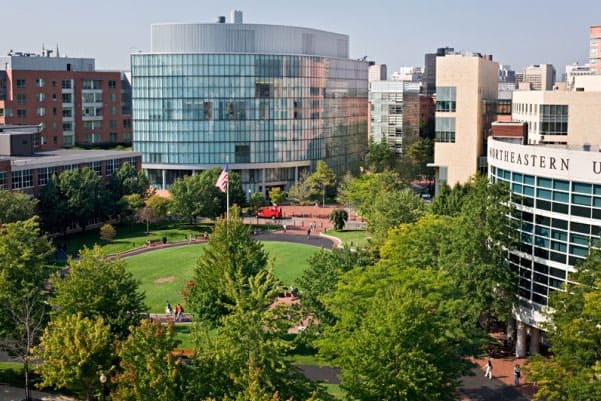
I got an email last week from a mom struggling with this very issue. Her son got into Yale with barely any financial aid andNortheastern_University_1 also got a full-tuition scholarship toNortheastern University.  The parents, who are in their 60s, would have to borrow six-figures to make Yale  financially possible.
To me this is an absolute no-brainer decision. Here was my advice, “Go to Northeastern!!!!”
This case also illustrates something else that’s common – a high-income teenager who gets nothing from an Ivy League school can routinely snag big, fat merit scholarships from countless other schools.
I’ve heard from so many moms and dads focused on underwriting an elite-school education through my course (there is still time to register if you’re interested), in my talks and through my blog, that I felt compelled to write a post pointing out some key things these parents need to know.

You don’t have to go to an elite school to succeed!

This seems incredibly obvious to me, but it isn’t to many parents in wealthy communities that seem to view 13527586992j82fgetting into prestigious colleges as some kind of trophy sport. For some parents, it becomes an obsession while their kids are still in diapers.
A Princeton admission rep once told someone I know that parents with preschoolers ask her what private schools their children should attend to boost their ultimate chances of a Princeton admission. Wow!
Even if I was to concede (and I’m definitely not!) that all the best jobs in the entire country go exclusively to the graduates of the most highly ranked colleges and universities, that would leave about 99.5% of jobs left to the rest of us.
If you don’t believe me, take a few minutes some day and look at your LinkedIn contacts. I bet most, if not all, of 64VZAhLthe most successful contacts you have did not attend a trophy school!
I made the LinkedIn suggestion recently when I was giving a talk at a financial conference in Las Vegas that attracted some extremely successful, fee-only financial advisors from across the country. When someone asked about the elite school advantage (he assumed there was one), I reacted by instructing anyone who had attended an Ivy League school to raise his/her hand. No one in the room did.
There have been some excellent and highly touted studies on whether an Ivy League bachelor’s degree conveys a professional advantage for students. The main conclusion of these papers was this:  students who attend Ivy League institutions and equally bright students who apply but get rejected from Ivy League schools end up making the same amount of money in their careers. These are bright and motivated students, after all, who can succeed wherever they go to school.
There was an exception to the research finding.  Minority and first-generation students who don’t enjoy the same advantages as the students whom the Ivy League schools specialize in educating – wealthy students  – did gain an advantage from attending these schools.

This Should Make You Feel Better

What should make parents feel better is this conclusion from Alan Krueger, the famous Princeton economist and coauthor of the studies:
He pointed out that the average SAT score at the most selective college that students apply to is a better predictor of their future earnings than the average SAT score at the college they attended. Read that again and let that sink in!
Here are excellent summaries from The New York Times and the Brookings Institute on what the famous Ivy League studies uncovered:

Revisiting the Value of Elite Colleges

 Who Needs Harvard?

It’s What You Do in College That Counts!

A Gallup survey conducted with Purdue University last year provided further evidcaitlinence that people should really stop fixating on the elite schools.
The survey results indicated that the type of institution that college graduates attend matters less to their future happiness at home and work than the experiences they have at whatever college that they end up at. In fact, the survey concluded that whether respondents attended an elite school, a public flagship, a  private college or a regional state school didn’t matter at all.
I wrote the following blog post about this survey and used my daughter Caitlin (see photo), a Juniata College graduate, to illustrate how you can be incredibly successful at a college that most people have never heard of:

How My Daughter Made the Most Out of College

Striving for elite schools can cripple teenagers mentally

Finally, I’ve left the most important factor in the college-admission rat race for last. What mental-health price are teenagers paying who are aiming for these elite schools?
I had a mom in my class wonder last week if the burnout her daughter, a junior, is experiencing is normal. The girl is taking four AP classes and a honors class on top of all her extracurricular activities. The mom is worried how her daughter is going to do when she’ll face this crushing load while visiting colleges, applying to schools and taking her standardized tests.
I encounter this issue a lot when I talk at schools in high-income areas with ambitious parents. What I tell them is that their children do not have to be super human. There are many schools that would love high-achieving students whether they take four AP classes a semester or two or one and will reward them with merit scholarships.
I see a lot of panic at these schools where parents worry that other students are pulling ahead academically so they pile on more AP classes. At the high school where my husband attended, the premiere public school in Denver, some students are starting Calculus as freshmen to try to gain an edge. It’s nuts!
This academic escalation can have tragic consequences.
I’ll be giving a talk at Gunn High School in Palo Alto this spring (I’ve given several talks at Silicon Valley high schools) that has experienced eight student suicides in roughly the past five years. 
I would highly urge parents of teenagers attending these pressure-cooker high schools to read a wonderful book written by Madeline Levine entitled, The Price of Privilege: How Parental Pressure and Material Advantage Are Creating a Generation of Disconnected and Unhappy Kids.
Here is a guest post from my blog recently that synthesizes Levine’s message that is definitely worth reading:

Why Affluent Teens Are Miserable

Bottom Line:

There are amazing colleges and universities in this country, many of which are under the radar, that offer excellent opportunities for their students.
It’s important to know that nationally around 75% of students get into their first-choice school. At most colleges and universities, it’s actually a buyer’s market not a seller’s market. Students have many, many choices if they are savvy enough to not just look at the same old three or four dozens schools that smart, high-income students tend to focus on.

Thursday, October 2, 2014

4 Key Tips For Ivy League Admission

There are no guarantees in the college admissions game, especially at name-brand institutions like those in the Ivy League. Not everyone is going to gain admission, even if, as I noted in my previous post, they meet the top benchmarks for acceptance: stratospheric test results and transcripts. 34,295 students applied to Harvard for the Class of 2018, and only 2,023 (5.9%) gained admission. Harvard could easily fill a second class that’s just as qualified with students from the “no” pile.
So how do you improve your odds of admission with such a super-competitive applicant pool? Since I only attended an Ivy League school, Harvard, for summer debate camp, I am hardly the expert here. Thus, I turned to a specialist in college admissions counseling, Dr. Kat Cohen, of the appropriately entitled education consulting concern, IvyWise. Here’s a paraphrase — with my advice sprinkled in — of what the good doctor ordered:

1.   Start Preparing As Early As Possible

Colleges look at all four years of high school grades, courses and extracurricular involvement. They want to know that students are challenging themselves each year, and deepening their involvement in activities that interest them. Or, as I routinely tell high school students (not that they listen), college admissions teams want to see that you are a master of one thing (in my case, it was policy debate), not a jack of all extracurriculars. Sustained extracurricular involvement over all four years of high school is, thus, mission critical. Colleges, like marriage prospects, like future employers, want to see that you’re committed to your interests.
English: Widener Library, Harvard University 2009
English: Widener Library, Harvard University 2009 (Photo credit: Wikipedia)
However, please don’t get involved in an extracurricular activity because you think it will “look good” on your college application. Get involved in a project or activity that deeply engages you. If that’s football, or chess, or the math club, or theater, or social work of some kind, it’s all good. The main thing is passionate commitment. Remember: elite colleges are not asking you to be “well-rounded.” They are looking to build well-rounded classes around a pool of world-class specialists.

2. Take Harder Courses With Each Advancing Year

This one is a no-brainer. Just as college courses are designed to get more rigorous and intense with each passing year, so too should your high school courses. As I noted in my previous post, Superhuman High School Transcripts Are Key to Ivy League Admission, colleges want to see students taking harder courses each year on an upward grade trend so they can tell if you are prepared for a heavy college course load. So, take the most challenging courses you can find at your school or nearby community college. And work hard to get the best possible grades in these college-level courses.

3.     Essays Matter: Don’t Slack On The Common App

Highly selective institutions, like those in the Ivy League, ask supplementary essay questions in addition to the main Common Application essay. For example, Brown and Columbia, ask variations of the “Why This College?” essay. These supplemental essays are very important because they are often school-specific and serve as a way for the college to get to know you better. It’s important for students applying to any selective school, let alone the Ivies, to submit well-written, compelling essays that convey their voice, interests, who they are as a person and student, and how they would contribute to the campus community. Generic pabulum about how you look up to your wonderful grandma isn’t going to cut it.
I would add that just as in the job market, elite institutions, like elite employers, want to know that you’ve done your homework on the school, what it is about, and how you specifically fit into its mission (both in the classroom and out). However, please don’t make this stuff up. This is why it is so important to know what you want out of college before you even apply. Instead of forcing yourself into what the college wants, find out what you want first. That will make answering college-specific questions so much easier and natural.

4. Boost Your IQ (Interest Quotient): Demonstrated Interest Matters

With more students applying to more colleges than ever beforecolleges are having a difficult time predicting yield, or the percentage of admitted students who end up enrolling. Colleges, especially highly selective institutions that might be battling against one another for highly qualified applicants, want to admit students who genuinely want to attend their specific school and are, thus, likely to enroll if admitted. Because of this uncertainty and the pressure to manage yield, more colleges are considering demonstrated interest — the level of interest students have shown in their specific school — to predict who is most likely to enroll and who isn’t. Things like visits, contact with the admissions office, interviews, applying early, are all considered elements of demonstrated interest. Applying in the early round, in particular, is one of the best ways for students to demonstrate interest, as early decisions are binding (meaning a student must attend if admitted) and single-choice early action prevents a student from applying to another private institution until they receive a decision from the first school.
Early admission rates at Ivy League schools can be much higher than the regular admission rate. For example, for the Class of 2018 Harvard admitted 21% of applicants in the early round, and with an overall admit rate of 5.9%, that means Harvard admitted just 3% of applicants from the regular admissions pool. So, boost your IQ, and dramatically improve your odds.