A resource of information for North Tahoe High School students, parents, and staff. Many posts are articles acquired elsewhere and re-printed for your convenience.
If you are hoping that your children ultimately attend a university, the schools on your dream list are probably all research institutions
Universities with the best-known brand names fall into this category. If you look at the top 50 national universities in U.S. News & World Report’s rankings, for instance, it’s likely you will recognize the names of all or nearly all of them. At the top are Princeton and Harvard and roughly 50 spots down are schools like Boston University and Tulane. You surely recognize those names too.
In contrast, it’s unusual for most Americans to recognize the names of any liberal arts colleges. Perched at the top of U.S. News’ liberal arts college rankings are Williams and Amherst colleges, which you’ve probably heard of. But the name recognition disappears quickly on this list. Schools making the top ten list include Bowdoin College (ME) and Carleton College (MN) while at the 50th spots are Denison (OH) and DePauw (IN).
It would be an unfortunate mistake, however, to assume that because research universities are better known and more popular that they will automatically be the best option for your children.
Before you can determine whether a research university is the best choice for your child, you need to understand what these institutions offer.
If paying for college is going to be a challenge, and it usually is, it’s important that you obtain your Expected Family Contribution before your begin looking at colleges with your teenagers.
In fact, obtaining your EFC should be the FIRST STEP you take in the college process.
Here is a quick rundown of what an EFC is, why it’s important, how
you can obtain this critical figure and what you should do after you’ve
generated it.
No. 1:
An Expected Family Contribution is a dollar figure that represents
what financial aid formulas believe you should be able to pay for one
year of a child’s college education.
Families with adjusted gross incomes of $24,000 have an automatic EFC
of $0. The EFC for the average American household with an AGI of
$55,000 will usually range from $5,000 to $6,000. There is no cap on
EFCs so some wealthy families will have EFCs that exceed the cost of an
expensive private university.
No. 2:
Determining if a student will be eligible for need-based aid requires
subtracting the EFC from a school’s cost of attendance. The more
expensive the school is, the more likely the student would qualify for
financial assistance.
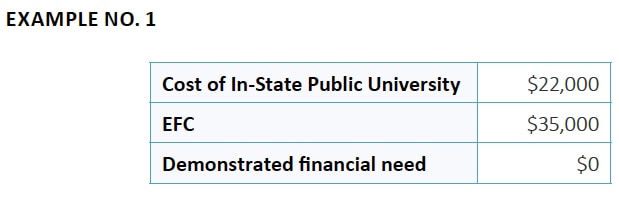
In the first example, the student wouldn’t qualify for any need-based
help because the family’s ability to pay exceeds the cost of the
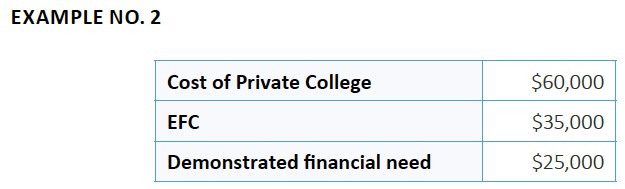
school. In the second scenario, however, the same student would be
eligible for up to $25,000 in need-based aid from the private college
because the price of this institution is far more expensive and exceeds
the family’s EFC.
No. 3:
Families, who discover that they have a high EFC and aren’t eligible
for need-based financial aid, should look for schools that provide merit
scholarships that are given regardless of need. Most schools fall into
this category.
No. 4:
If your EFC is modest, you should search for schools that provide
excellent need-based assistance. Far fewer colleges and universities fit
into this category.
No. 5:
Families with household incomes of $60,000 to $80,000 and above
typically find that they do not qualify for need-based aid at state
universities, but they may qualify for need-based aid at private
schools.
No. 6:
Families will usually have to pay more for college than their EFC
indicates they can afford because most schools do not meet 100% of a
student’s demonstrated financial need. Consequently, it’s important to
identify the most generous colleges and universities that would consider
your child an attractive candidate.
No. 7:
It’s best to get a ballpark idea of what your Expected Family
Contribution will be as early as your child’s freshman year in high
school. Obtaining a preliminary EFC will give you a rough idea of the
minimum amount that you will be expected to pay for college.
No. 8:
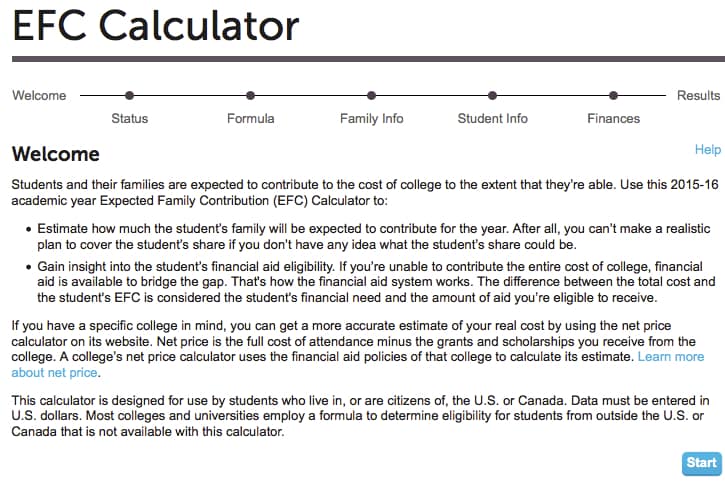
You can obtain your Expected Family Contribution by using the College Board’s EFC Calculator.
With this calculator, you’ll want to obtain your EFC using the federal
and institutional formulas. Here is a screenshot of the calculator:
The calculator will produce an EFC using the federal methodology that is linked to the Free Application for Federal Student Aid.
The calculator will also produce an EFC using the institutional methodology, which is linked to the CSS/Financial Aid PROFILE,
which is a product of the College Board. The vast majority of private
and public colleges and universities only use the FAFSA while 260 mostly
private, selective schools use the PROFILE.
No. 9:
When you complete the FAFSA, you will receive your official federal EFC via an electronic document called the Student Aid Report.
The SAR will include the family’s Expected Family Contribution near the
top of the report and also provide all the information that the family
provided on the FAFSA. Parents should check for accuracy.
No. 10:
If you need to file the PROFILE, you will not receive your EFC from
the College Board, which owns and operates this financial aid
application. Institutions that use the PROFILE customize their aid
applications by choosing from hundreds of different questions so you
will end up with a different EFC for each school.
No. 11:
You should ask each PROFILE school for your EFC if the institutions
do not include this important dollar figure on your financial aid
awards.
No. 12:
Many schools fail to include a family’s EFC on their financial aid
awards. Some institutions suggest that including the EFC on their aid
letters will confuse families. More likely, schools don’t want to share
EFC figures with families because parents would then be able to
determine if the package is stingy.
No. 13:
Once you have your EFC and the financial aid package, compare your
EFC with what a school is offering. Let’s say that the cost of a school
after deducting institutional grants is $39,000 and your EFC is $28,000.
That means there is an $11,000 gap between what your EFC suggests that
you can pay and what the school wants to charge you.
No. 14:
Plug new numbers into the EFC calculator if your financial situation
changes due to such things as a divorce, separation, death, disability,
job loss or the care of an elderly parent.
No. 15:
Don’t be surprised if your EFC figures seem too high. The financial
aid formulas as flawed and aren’t designed to accurately measure what
you can actually afford to pay for college!
As the cost of attending college increases each year, some high school graduates may wonder how well they could do without a college degree. While occupations that only require a high school diploma are often low-paying jobs, several pay well above the median wage. To identify the highest-paying jobs you can get with a high-school diploma, 24/7 Wall St. reviewed wage and employment data from the Bureau of Labor Statistics’ 2013 Occupational Employment Statistics database and job descriptions from the Occupational Outlook Handbook. The jobs that made the list had a median annual salary of at least $60,000 and did not require formal education beyond a high school diploma, according to the BLS. Forecasts for job growth between 2012 and 2022 are from the bureau’s Employment Projections program. 24/7 Wall St. also reviewed job descriptions from O*Net Online database, developed by the Department of Labor. Jobs that were too similar, or which had a high percentage of self-employed workers, were excluded. From 24/7 Wall St., these are these are the highest paying jobs for high school graduates:
The Hess Gas Plant in Tioga, N.D.KAREN BLEIER/AFP/Getty Images
Slide 2 of
10. Gas plant operators
Median annual income: $63,680
Total number employed: 13,890
Projected change 2012 to 2022: -8.8%
Gas plant operators process and distribute gas for utility companies. Cheap, abundant natural gas is likely to provide some demand for gas plant operators, even as jobs at power plants are projected to fall. The Energy Information Administration (EIA) forecasts that in the coming decades natural gas will exceed coal as the nation’s leading source of electricity. The work of plant operators can be dangerous and stressful, which may explain the relatively high median salary of $63,680 as of 2012. However, with such a high median pay, gas plant operation is one of the better-paying jobs people can take on with a high school diploma.
Workers make repairs to power lines after a series of tornadoes in El Reno, Okla. in 2013.Getty Images
Slide 3 of
9. Electrical power-line installers and repairers
Median annual income: $64,170
Total number employed: 111,350
Projected change 2012 to 2022: +8.9%
Each year, homes across the U.S. are hit hard by natural disasters that leave areas without power or phone service for hours or days at a time. Responsibility for fixing damaged wires falls on the roughly 111,000 electrical power-line installers and repairers in the country. In fact, the BLS cites challenging weather conditions as one reason for the high median salary of such workers. More frequent storms in recent years likely influenced estimates of future job growth in this area, which is expected to increase by nearly 9% between 2012 and 2022. Employers offer extensive training programs to prospective employees, which act as a substitute for tertiary education. Nonetheless, employers expect their workers to have a basic knowledge of algebra and trigonometry.
U.S. Postal worker Sukhwant Dhillon moves cartons of sorted mail at the U.S. post office sort center in San Francisco.Getty Images
Slide 4 of
8. Postmasters and mail superintendents
Median annual income: $65,150
Total number employed: 17,930
Projected change 2012 to 2022: -24.2%
Postmasters and mail superintendents manage and coordinate the activities of postal workers. A typical postmaster or superintendent made over $65,000 in 2013, and the top-paid 10% took home $84,900 or more. However, postal service jobs in general are expected to decline considerably between 2012 and 2022. In all, employment in postal service jobs is expected to drop by 139,100, or 28%.
A Union Pacific freight train carries goods east near of Palm Springs, Calif.Getty Images
Slide 5 of
7. Transportation inspectors
Median annual income: $65,950
Total number employed: 23,970
Projected change 2012 to 2022: +11.2%
Transportation inspectors work in industries such as rail transportation, air transport and urban transit systems. Workers in these occupations mostly inspect equipment to ensure that both people and cargo are transported safely. Like many of the jobs on this list, on-the-job training takes the place of formal education. The median salary for transportation inspectors in 2013 was nearly $66,000, with higher-end pay for workers reaching above $112,690.
Harrah's Las Vegas Hotel and Casino Las Vegas.Getty Images
Slide 6 of
6. Gaming managers
Median annual income: $66,200
Total number employed: 4,460
Projected change 2012 to 2022: +7.5%
According to a recent Scotiabank report, the U.S. gaming sector has grown at a relatively slow pace compared with the rest of the world in recent years. Still, the gaming and casino industry is extremely large. The industry employed more than 363,000 people in 2012, according to the American Gaming Association. Gaming managers made up about 4,460 employees in the sector as of last year. Gaming managers direct and oversee the gaming operations within a casino. They often have several years of experience working the slots or table games for a lower pay. Although they must be licensed by a state or regulatory agency, gaming managers typically do not need a degree above a high school diploma to make more than $66,000 annually.
An operator at American Electric Power's Mountaineer coal power plant in New Haven, West Virginia, works in the control room for the plant's carbon capture facility.SAUL LOEB/AFP/Getty Images
Slide 7 of
5. Power plant operators
Median annual income: $68,100
Total number employed: 39,810
Projected change 2012 to 2022: -10.8%
Power plant operators earned a median pay of $68,100 in 2013 managing the systems that distribute and generate electric power over an area. Although workers with college or vocational degrees are preferred, only a high school diploma is necessary because the operator undergoes extensive on-the-job training both in the classroom and the plant. Operators often work in shifts because power plants operate around the clock. It is likely that pay for this position is high due to the negative aspects of working variable hours, especially late night shifts.
An airline pilot walks through the terminal at Ronald Reagan Washington National Airport in Arlington, Va.SAUL LOEB/AFP/Getty Images
Slide 8 of
4. Commercial pilots
Median annual income: $74,470
Total number employed: 37,340
Projected change 2012 to 2022: +9.4%
Despite larger airline companies often requiring a bachelor’s degree, smaller companies that offer planes for charter, photos or tours are often eager to hire licensed pilots who have logged the requisite number of hours. To obtain a flying license from the Federal Aviation Administration also requires medical, written and flight exams. Future pilots can gain experience by going to flight school or by hiring independent instructors. The BLS anticipates that the number of commercial pilots will increase 9% by 2022, making it one of the faster growing jobs on this list. A typically commercial pilot earned nearly $75,000 in 2013, with the top 10% of pilots bringing in more than $136,000.
A Boston Police detective searches a crime scene for suspicious material.Getty Images
Slide 9 of
3. Detectives and criminal investigators
Median annual income: $76,730
Total number employed: 109,960
Projected change 2012 to 2022: +2.0%
Detectives typically begin their careers as police officers. Becoming a police officer usually involves physical exams, a written test and a drug test, in addition to training at a policy academy. While many police officers and detectives have a college degree, the minimum educational requirement is a high school diploma. For those who are able to become detectives and criminal investigators, the pay is often quite high. The median annual income in the profession was $76,730 in 2013, and the top-paid 10% earned more than $125,000.
A typical installer or repairer earned more than $78,000 in 2013.Shutterstock
Slide 10 of
2. Elevator installers and repairers
Median annual income: $78,640
Total number employed: 21,270
Projected change 2012 to 2022: +24.6%
Elevator installers and repairers do not need a bachelor’s or associate degree. However, they do need years of apprenticeship. As part of the five-year program to become an elevator installer and repairer, every year apprentices “must have at least 144 hours of related technical instruction and 2,000 hours of paid on-the-job training,” the BLS notes. In that time, apprentices study electrical theory, math and physics, among other subjects. The majority of states also require licensing. Workers who complete these requirements are well compensated. A typical installer or repairer earned more than $78,000 in 2013, and some earned more than $100,000.
A high level of management skill is required to plan and direct warehousing and shipping logistics.Shutterstock
Slide 11 of
1. Transportation, storage and distribution managers
Median annual income: $83,890
Total number employed: 102,610
Projected change 2012 to 2022: +4.9%
Transportation, storage and distribution managers are responsible for much of the infrastructure that businesses rely on to ship goods domestically and internationally. The shipping and storage industry is very important for global trade and commerce. A high level of management skill is required to plan and direct the logistics involved around warehousing and shipping. Even though a minimum requirement for this job is a high school diploma, most people holding this title have a bachelor’s degree. However, for those able to land the job, the pay is quite high. The annual median wage is more than $83,890, and for some, notably in oil transportation, annual pay can exceed $140,000.
With so many people and so much information, it is easy to become overwhelmed. A little preparation can make a big difference.
Consider the options before diving in. If preregistration is available, do so and review materials for options. Seminars are often given at a specific time so check the schedule upon arrival. If students have a college list, visit those on it first. Plan to take longer than expected. Lines can grow long and fast, so arrive early for best chance to meet and speak with college reps. Don’t dismiss schools without lines. They may turn out to be hidden gems.
Information sources have their own agenda. College representatives use college fairs as marketing opportunities to encourage interest in their institution. They distribute information via brochures and other items to attract attention, meet prospective students, and encourage them to visit and apply for admission. Students can use this to their advantage by getting the rep’s contact information. Follow-up with questions in a quieter and more personalized setting.
Students and parents should set their agenda. Students attending college fairs include high school sophomores, juniors and seniors but each are in a different phase of the college search process. For those first starting, use the fair to get educated about higher education. Sit in on seminars, visit college booths and gather college brochures to review at home. Students who have already researched schools can use the fair to find answers to questions not contained in written info and college websites. Speak with college staff, many of whom attended the school they represent, for insider tips about the campus, surrounding area, programs and internships. Students ready to apply can focus on college comparisons and unique opportunities that will help students grow, thrive and be best prepared for graduate school or careers.
Parents can help their student. College representatives are interested in speaking with prospective students but many get tongue-tied. Have a conversation to brainstorm questions to ask and an elevator speech the student can use to introduce himself. Step back to let the student hone some independence and leadership skills to vest herself in the college process. Attend seminars for the first time or as a refresher to get updated information because both the admission and financial aid processes can change at any time.
College-bound students receive a lot of mail from colleges. Students and families may think these materials are just a good way to learn more about colleges, and that is partly correct. However, the viewbooks and publications students receive in the mail or pick up at college fairs are also marketing materials. Colleges and universities spend tens of thousands of dollars to produce, print and mail these items to prospective students.
The majority of college publications will have a few things in common. They will:
Provide general information about the institution, including majors, location, admission requirements, cost of attendance and financial aid information.
Present beautiful pictures of the college campus, usually showing the best weather the area has to offer.
Show attractive students smiling at the camera and/or in deep discussion with other students or professors.
Have catchy or inspirational phrases and themes used throughout the publication.
Describe the location and all of the advantages the location offers students.
Most of the publications will be beautiful and eye-catching. They will boast about the institution and will make the reader want to attend. There will be no negative descriptions of the college. When looking at college publications, most people do not relate them to other advertisements that come in the mail. They are very similar to the catalogs that big corporations produce for consumers. The whole idea behind any marketing publications is to sell a product. In the case of colleges, the publications are trying to sell a four-year college degree and the experience that goes along with it. Much time, energy, and money goes into producing beautiful publications to wow prospective students and make them want to attend the institutions.
College viewbooks are beautiful and will make any college look great and give the feeling it is a wonderful place to attend. While all colleges have something special to offer students, they might not be the right fit for each student. College publications, websites, and any marketing materials will not tell students everything about a college. More importantly, although they do a great job of showing what the campus community is like, marketing materials cannot give students an understanding of how they will feel on campus.
Students should reach out to colleges and get viewbooks and publications from colleges they are considering. They provide a lot of information and can answer questions students may have as they are researching college options. In addition, signing up for college mailing lists lets colleges know students are interested and may provide information that is not available in the general publications or the website. However, as students dig deeper into the college search, they should visit colleges they are seriously considering. A college visit is the only way a student can get the full feeling of what the campus community is like and how they will feel on campus. Students should test drive colleges they are considering just as they would when purchasing a car. It is the only way to make sure students are making the right decision when making this large decision that will amount to a large purchase.
The next time those college publications come in the mail, remember they are marketing materials. Students should use them to education themselves about the colleges, but understand they will not give all of the answers students need. Viewing college viewbooks is a lot like window-shopping; students will only see what the colleges want them to see. After window-shopping and narrowing down what they like and dislike, students should move on to testing out the colleges for themselves by visiting the campus. The college visit is the best way to try the college out to make sure they feel it is a good fit for them.
If your family will need to depend on financial aid to attend college, your best bet is to find a school that will offer an excellent financial aid package to your child.
A handy way to assess the generosity of any school is to look at the percentage of demonstrated financial need it typically meets for its students.
Teenagers, who earn an acceptance into a school that meets 100% of need, can end up winning the educational equivalent of the lottery. Whether it will be a great deal will largely depend on how a particular school calculates financial need.
Colleges and Universities That Meet 100% of Need
To make the search easier, here are the schools that I know of that say that they meet 100% of demonstrated financial need for all or the majority of its students. If you are aware of others, please let me know in the comment box below.
Also on this list I included schools, which I boldfaced, that meet at least 94% of need for the majority of its students.
Amherst College (MA)
Barnard College (NY)
Bates College (ME)
Boston College (MA)
Brown University (RI)
Bryn Mawr College (PA)
Bowdoin College (ME)
Bucknell University (PA)
California Institute of Technology
Carleton College (MN)
Claremont McKenna College (CA)
Clark University (MA)
Colby College (ME)
Colgate University (NY)
College of the Holy Cross (MA)
College of Wooster (OH)
Colorado College (CO)
Columbia University (NY)
Connecticut College (CT)
Cornell University (NY)
Davidson College (NC)
Denison University (OH)
Dickinson College (PA)
Duke University (NC)
Dartmouth College (NH)
Emory University (GA)
Franklin and Marshall College (PA)
Franklin W. Olin College
Georgetown University (DC)
Gettysburg College (PA)
Grinnell College (IA)
Hamilton College (NY)
Harvey Mudd College (CA)
Haverford College (PA)
Harvard University (MA)
Johns Hopkins University (MD)
Kenyon College (OH)
Lafayette College (PA)
Lehigh University (PA)
Macalester College (MN)
Massachusetts Institute of Technology (MA)
Middlebury College (VT)
Mount Holyoke College (MA)
Northwestern University (IL)
Oberlin College (OH)
Occidental College (CA)
Pitzer College (CA)
Pomona College (CA)
Princeton University (NJ)
Reed College (OR)
Rice University (TX)
Saint John’s College (NM)
Saint Olaf College (MN)
Scripps College (CA)
Sewanee: The University of the South (TN)
Smith College (MA)
Stanford University (CA)
Swarthmore College (NY)
Thomas Aquinas College (CA)
Trinity College (CT)
Tufts University (MA)
Tulane University (LA)
Union College (NY)
University of Chicago (IL)
University of Notre Dame (IN)
University of Pennsylvania (PA)
University of Richmond (VA)
University of Rochester (NY)
University of Southern California
Vanderbilt University (TN)
Vassar College (NY)
Wabash College (IN)
Wake Forest University (NC)
Washington and Lee University (VA)
Washington University, St. Louis, (MO)
Wellesley College (MA)
Wesleyan University (MA)
Williams College (MA)
Wheaton College (MA)
Yale University (CT)
Generous Colleges
What you’ll notice about the above list is that the schools are highly selective. Many of these schools can provide 100% of need because they are wealthier with bigger endowments than their peers, but also because the majority of students who attend these schools are typically high income. With the wealthy children paying the sticker price or getting a modest merit scholarship, this generates more money for financial aid.
How Percentage of Need Met Works…
Let’s say the financial aid formula says your family can afford to pay $15,000 for one year of college. (That’s represented by your Expected Family Contribution.) Your child gets into a $50,000 school that promises to meet 100% of its students’ financial need. That means the school will provide $35,000 in aid.
Schools will look for outside help first to build that $35,000 package. If the child qualifies for the federal Pell Grant for low-income students and an applicable state grant, that will be put into the package first. Nearly all schools also put a federal direct loan (formally known at the Stafford) into the package. The maximum direct loan limit for a freshman is $5,500. After that the school would kick in its own institutional money.
In this case, let’s assume the child doesn’t qualify for any state or federal grants at a school that meets 100% of need.
$50,000 Cost of Attendance
Minus $15,000 Expected Family Contribution
Aid $35,000
After the federal direct loan is subtracted, the family would get nearly $30,000 in grants/scholarships (free money) to attend this school. Some of the most elite schools won’t put in a federal Loan.
In contrast, the majority of schools in this country would “gap” this student. A school might provide just $10,000 or $15,000 or $20,000 or even $0 dollars to meet this child’s need.
Definition of Need
The financial aid packages will vary based on the underlying aid formula that each school uses. Schools that use the CSS/Financial Aid PROFILE (about 260 schools – nearly all private) can modify the standard aid formula in a variety of different ways. The school, for instance, can vary in how it assesses home equity, business assets, divorce and much more. Here is a recent post that I wrote about how schools vary in how they treat home equity:
You can obtain the percentage-of-financial-need-met figures by heading to the College Board. I wrote the following blog post last year that explains how to generate these figures:
If your family will need significant financial aid, it’s important that your child be the best student possible so that he or she will be more likely to qualify for the caliber of schools that are generous.
Showing sincere interest is a sure way for college applicants to make a good impression at their No. 1 pick.
An academic passion, initiative and a proven interest in a college are key to getting your foot in the door – and they’re only some of the attributes admissions officers are looking for in their ever more competitive applicant pools.
Sixty-four percent of colleges and universities surveyed by the National Association for College Admission Counseling saw a jump in the number of applications for entry in the fall of 2012, the most recent stats available, as students continued to apply to a greater number of schools and interest increased from abroad.
The same forces are persisting this year, particularly at the top of the heap. Stanford Universityaccepted just over 5 percent of the 42,167 applications it received for the class of 2018; Yale's acceptance rate was 6.3 percent.
Scary as those statistics may be, it's important to remember that, on average, colleges are still accepting almost two-thirds of their applicants, according to NACAC.
"For most kids, it's not that hard to get into college as long as you're doing the right thing," says Mark Montgomery, an educational consultant in Denver. U.S. News talked with admissions officers, independent college counselors and high school guidance counselors to find out what the right thing is.
1. Develop a smart short list: Picking colleges requires a long look inward as well as study of all those school websites. "Pause and assess who you are, what you're good at," advises Judy Muir, an independent college counselor in Houston. Then consider how your learning style and other preferences fit with each college's strengths.
Ted Spencer, director of undergraduate admissions at the University of Michigan—Ann Arbor, says you should be able to come up with five reasons for applying to every school on your list.
Then run the list by your guidance counselor to be sure you're being realistic about the chances for admission. Some high schools have software that can tell you where you'd stack up against past applicants to a college.
2. Consider early options: Some 47 percent of colleges reported an increase in the number of applicants accepted through binding early decision for the fall of 2012 – meaning the students promised to attend if accepted – and 68 percent saw a jump in nonbinding early-action acceptances, where students get word early, without an obligation, according to NACAC.
Montgomery always advises students to apply early decision if they absolutely know where they want to go and won't need to weigh financial aid offers, since colleges like to admit students who are a sure thing, and the odds of clearing the bar are often better.
"We have kids whose applications we're reading in the regular decision round who go on the waitlist, when they would have been admitted early," says Mike Sexton, vice president for enrollment management at Santa Clara University in California.
3. Show sincere interest: As it becomes easier for students to apply to multiple schools electronically and by using the Common Application, admissions officers are alert for "stealth candidates" who do nothing but fill out the forms. If you want to be taken seriously, "you've got to show them some love," says Caroline Brokaw Tucker, an independent college consultant at Connecticut-based Dunbar Educational Consultants.
Visiting, the best way to get a feel for schools, is also the best way to show you're interested. Take the tour, but also meet with admissions officers. Ask questions. If you can't visit, take advantage of local college fairs and every other option for contact.
"Write to the admissions office, sign up on their Facebook page – anything to let them know you think they're the bee's knees," says Montgomery.
"I made sure I stood out," says Abigail Fleming of Evansville, Indiana, who applied to 10 small liberal arts colleges and, after visiting a few, zeroed in on Beloit College in Wisconsin. She stayed in touch with the admissions office when she had questions, and even drove three hours to a college fair to connect with the school again. She's now a freshman at Beloit.
4. Pay attention to details: Optional essays? Write them. A chance to elaborate on your extracurricular activities? Take it. For students on the bubble, that bit of extra effort can make the difference in whether or not you're admitted.
Thyra Briggs, vice president for admission and financial aid at Harvey Mudd College in California, advises putting serious thought into the teachers you ask for recommendations. "Don't always choose teachers who gave you a straight A," she says. A recommendation from a teacher who watched you struggle can "show how you respond to challenge."
Finally, keep careful track of deadlines. And meet them.
5. Take the lead: Throughout the process, it's really crucial to remember that you, not your parents, are running the show. Take charge of creating your list, of arranging visits and interviews (and then do the talking), and of reaching out to the admissions office with questions on your own, rather than having your mom do it on her lunch hour.
"It's refreshing when a student does that," says Rick Clark, director of admission at Georgia Institute of Technology, "because it's so rare."
This story is excerpted from the U.S. News "Best Colleges 2015" guidebook, which features in-depth articles, rankings and data.