Showing posts with label SAT. Show all posts

Thursday, October 29, 2015

4 Vocabulary Strategies for the Redesigned SAT

Posted from: http://www.usnews.com/education/blogs/college-admissions-playbook/2015/10/26/4-vocabulary-strategies-for-the-redesigned-sat
By now, you are likely well aware that the SAT will change in 2016. These changes will not be cosmetic – the new exam prizes complex understanding rather than rote memorization.
At one time, teachers and tutors could reasonably recommend that a student study for the SAT by memorizing arcane vocabulary words. This is no longer a winning strategy. Instead, the redesigned SAT emphasizes the importance of words in context. Here are four prep strategies to help you prepare for this new challenge.
1. Strengthen your understanding of the questions: Consider the sample vocabulary question that appears on pages two and three of this informational bulletin. The question, which concerns a topic that will one day be relevant to test-takers, asks readers to choose the best definition for "intense" given the context of the passage.
All four options are valid substitutes for "intense," but B is the correct answer.
Why is this example important? It demonstrates the redesigned SAT's commitment to using words that students will often encounter in college classrooms, and it emphasizes the use of context clues over memorization. Given the shift in structure, it is crucial to use up-to-date study materials. 
2. Update your vocabulary lists: Words like "intense" are tier two words – that is, they are words that are commonly used by mature speakers and writers. Tier three words, which the College Board previously drew from for the SAT, are those that have limited or narrow applications.
There is insufficient space in this blog post to provide you with a set of tier two words to review prior to your exam date, but a brief Internet search will uncover a number of terms that can guide your studies. Once you compile a list, create flashcards that include all possible meanings for each word.
Next, write sentences that use each definition appropriately. Keep your list handy as you write papers for your classes, and try to incorporate these words into your assignments.
Writing can help you set the words in your mind, which may make them easier to recall under stress. As an added bonus, you will also have an impressive arsenal of vocabulary words to deploy if you register for the optional SAT essay.
3. Read often: The redesigned SAT did not just change its vocabulary terms. It also changed the kinds of texts that they appear in.
The texts will include literary works, as well as historical and scientific documents, some from the 19th and 20th centuries. Unless your high school is uncommonly rigorous, or you are preparing for AP exams in American history or literature, you may have limited exposure to such writings. 
The best way to prepare, then, is to simply increase your familiarity with these works. Choose a book from an earlier era, such as "The Great Gatsby," and mark any words that are unfamiliar to you.
Better still, mark any words that look familiar, but that do not quite fit the context. Look these words up in a dictionary, and write down the sentence in which you encountered the word. You can then use that sentence when studying.
4. Practice identifying context: As you complete various practice problems, keep context in mind. The redesigned SAT will not just ask for definitions, it will also ask you to select a portion of a passage that supports your answer. In other words, it is not sufficient to determine the meaning of a word – you also have to be able to justify your answer.
One way to approach this difficult project is to write justifications for the correct answers to sample problems, as well as arguments against the other answers. In the question cited above, for example, you could note that "emotional" is not correct since the passage is dispassionately discussing trends in employment.

Thursday, June 12, 2014

4 Strategies to Overcome Test Anxiety

Nearly all students experience text anxiety at least once in their lives. It is natural to do so when facing the GRE, SAT, or perhaps even a weekly quiz. However, test anxiety can interfere with students' logical reasoning abilities and their memories. It can even result in a serious mental block.
Remaining calm on your exam day can help you manage such anxiety and ultimately lead to improvements in your grades. Here are four strategies to do so:
Study early and get enough sleepEach person requires a different amount of sleep. Some students function beautifully on just five hours, while others need nine or more. Determine your ideal amount, then plan ahead for important exams by studying early. That way, you can avoid cramming the evening before and get the adequate amount of rest you need.
Take practice testsThis is not only a beneficial studying technique, but also a strong strategy to manage stress. Completing practice exams allows your mind to acclimate to the test format as well as the process of recalling specific information from memory. This can be especially helpful for standardized tests like the ACT and SAT, which require great mental endurance and critical thinking.
Practice exams can also help you build your confidence as you continuously increase your score. Simply feeling prepared and confident on test day can help mitigate stress.
Exercise in the morningExercising can enable you to dispel anxious feelings, thus allowing you to feel more relaxed during your test. It can also wake your brain, leading to a potential increase in cognitive functioning. This tactic makes particular sense for the ACT, GRE, SAT, and so on, when you can simply run around your neighborhood before your exam session. If you are fortunate enough to have the liberty to set your own class schedule, try to place gym time directly before your most difficult course (i.e. the one that is most stressful).
Relax and trust your preparationBefore you begin a test, devote several minutes to thinking about your prep plan. Do not worry about how you could have studied more--just remind yourself that you prepared effectively and efficiently. If you are still feeling stressed, try a simple relaxation technique like taking several deep, slow breaths; closing your eyes for a few moments; visualizing success, etc.
Happy testing!

Friday, January 31, 2014

When Should You Take the SAT or ACT?

A couple of years ago I listened in on a webinar about SAT strategies that impressed me. The guest speaker was Jeb Applerouth, who runs aneponymous test-prep firm that’s headquartered in Atlanta. Jeb gave me permission to share the following blog post where he discusses  whether there is an ideal time to take the SAT or ACT.   Lynn O’Shaughnessy
By Jeb Applerouth
March is the worst! Avoid it like the plague! Don’t you dare take October; that’s when the smart seniors are sitting. All the jocks take December, that’s the surest bet for a high score!
If you spend long enough in this business, you will hear chatter about choosing test dates strategically to garner a testing advantage.
One of my independent educational consultant friends recently reached out to me. She heard a rumor from another mom, while sitting in the basketball bleachers, that certain testsare considered “easier” based on the students takingpencil singlethem at that time. She wanted to know if she should have her clients prioritize any particular date.

There is No Statistical Advantage

How wonderful would it be to have the insider track on picking the right test date!
Unfortunately, in spite of the allure of being “in the know,” there is no statistical advantage in selecting one test date over another. That’s simply misinformation, being spread like wildfire in basketball bleachers across America.
I must admit that I too have been a purveyor of this particular brand of misinformation, driven primarily by having too small of a data set to draw any legitimate conclusions. Years ago, when I started keeping tabs on my students’ performance, I noticed some trends.
Back in 2002-2003, poring over my excel spread sheet, I noticed something. My students’ March scores were abysmal, but their May scores were amazing! Going off my extremely limited data set, I advised all my students: “Take May! May is the Way!” A few years later I changed my tune, and I was proselytizing June!
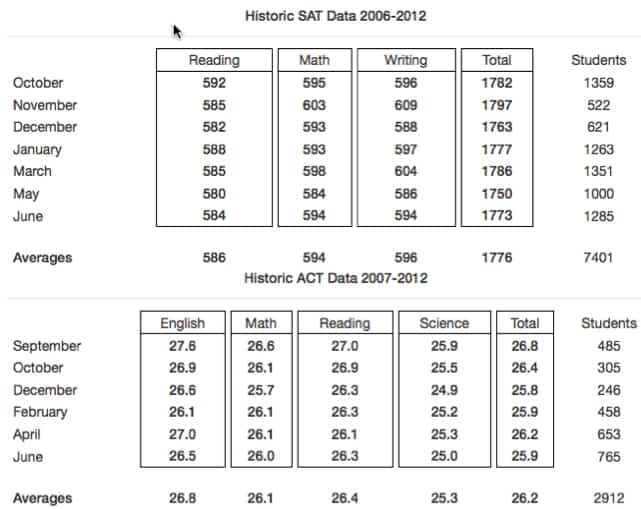
These days our data set has grown considerably. As a company, Applerouth has always been results driven and data focused. In our current data set, we have over 7,400 official SAT and 2,900 ACT results. Our findings do not come from flimsy anecdotal evidence: we are working from a legitimate data set. And this data set quickly wipes away any notions of preferential test dates.

Is There No Variance in Difficulty?

erasers small imageAlthough there is no consistent pattern, year over year, it is true that certain tests are objectively harder than others, and within a given test, certain sections are much more challenging than others.
Having taken over a dozen SATs and ACTs, I’ve experienced this first-hand. I have been slammed by particular science sections on the ACT, flummoxed by Math sections on the SAT. But the statistical equating process the College Board and ACT Inc. use, it turns out, is effective. The harder sections and test are balanced out by a different curve.
Additionally, if you take this test long enough, you realize that these companies recycle their content. SATs and ACTs are very expensive to create and calibrate; the testing companies are wise to get as much bang for their buck before retiring a test.
When a testing form is finally administered on one of the test-return dates – October, January or May for the SAT – December, April, June for the ACT- that particular test, now externally released, leaves circulation. On the December 2012 ACT, I was given the exact test form that I had already taken in 2010. As test forms are recycled throughout the calendar year, the notion of easy and hard dates loses further credence.
The Data tells all
Individuals may give more weight to the most recent data- suffering from recency bias: “the last two October administrations sure were tough! Avoid October!” Or they may privilege emotionally charged data points: “Billy tanked on December, but went up 300 points in May! Everyone should take May!” We need to take a long view with a robust data set; only then can we circumvent these cognitive errors and come to a clear understanding of the trends.
To dispel the myth of differential test date difficulty, I’m going to lay out the full data set as an appendix to this article. But I’ll summarize the data here. All of these results are from official testing administrations, reported by our students and their parents.
ACT
As you can see, the notions of an easy or hard test date do not bear out. The test dates are quite consistent in their level of difficulty. The appendix charts go into more granular detail. The only instances in which our data show a real swing in test difficulty correspond with a smaller than normal sample. Sampling bias in effect!

A few notes on the data

There is a slight maturation effect/test-retest effect, as students taking the early fall tests are more likely to be seniors who have already taken the test than are students taking the early winter tests. This effect is relatively weak, because for every test date, we have students taking the test for the first time, others for the final time, some having prepped with us, others having gone in to the test without any prep.

Wednesday, January 29, 2014

How students will benefit from the changes to the SAT

Beginning in 2016, high school students will complete a new version of the SAT. Other than having to adapt their test prep, why should students care? Because these changes will benefit them long-term, which is partially why these changes are coming into effect; they are meant to reflect learning that is clearly relevant to students’ lives, rather than seemingly arbitrary information that is only applicable to the exam itself. Students will gain tremendously from the updated SAT in two very important ways:
1. Increased accuracy – and honesty – in the admissions process
The SAT typically plays a central role in college and university admissions. Yet, over the years, higher education institutions have begun to cite a need for assessment measures that are able to better predict academic success with more reliability.
As an SAT tutor, I stress to clients that the current SAT is not an intelligence test. It is not a cumulative assessment of their high school years. It is an exam of strategy, often divorced from the realities of the American classroom. With these changes on their way, David Coleman of The College Board hopes to strengthen the test’s ability to determine how well students deploy the knowledge they learn in school. While strategy identification and application will undoubtedly continue to factor into students’ final marks, mastery of high school material necessary for college success will feature more prominently. The new SAT will, in theory, no longer represent an assessment measure with declining relevance to the admissions process where students with simply high knowledge of test-taking strategy fare better.
2. Consistency across all avenues of education
Though I possess two degrees and a secondary teaching certificate, in my 28 years, I have never utilized the term “compendious.” The same is true of “treacly,” though both words represent typical vocabulary selections on the SAT. These terms, in addition to various concepts that relate to grammar, mathematics, and paragraph composition, represent no context beyond the exam itself, and students who are familiar with them usually gain this knowledge outside the classroom – not within it.
Mr. Coleman hopes to alter this reality not only to reinvigorate the SAT’s importance within higher education admissions, but to align test content with educational standards. By truly standardizing what material appears on the SAT (as discussed above), as well as how it is presented and how it is solved, the exam becomes a holistic addition to American high school education, rather than a singular challenge with no direct correlation to the strategies and subject matter that college and university students require to succeed in higher education.
Ultimately, the actual release of the revised SAT in 2016 will be what proves whether or not its modifications can benefit high school-age individuals. Mr. Coleman’s and The College Board’s acknowledgements that change is necessary, however, represent an important first step.

Sunday, December 8, 2013

Give Thanks for Online SAT Test Prep Resources

Planning SAT preparation can be a test all by itself. Listening to advice from fellow test-takers, teachers and the vast world of online resources might overwhelm you as you devise a study plan that best suits you.
Start by narrowing your search with these five SAT prep resources that you'll be thankful for throughout your journey. 

(NTHS offers a great SAT Prep program called PrepMe through the Navaince Family Connection home page. When students login, the link is in the upper left hand corner)
1. Free practice exams: At the start of your SAT prep, it is important to assess your strengths and challenges on the exam. Taking a practice test is one of the best ways to decide how to tailor your study plan to your specific skills. Begin by trying the College Board's Official SAT Practice Test
Continue assessing your exam-taking skills throughout your prep schedule with free test questions and exams available online. Once you take a practice exam, try the College Board's skills assessment tool for tips on developing specific skills. 
Scoring your timed practice sections is the only way to understand yourself as an SAT test-taker and to determine your most personalized approach to the exam. 

2. Writing resources: The SAT essay section moves quickly and serves up a challenge in the same way that any timed writing exam does. As with all aspects of SAT prep, the best way to become comfortable with the essay is to practice at least four to five timed essays before test day, and score them. 
Scoring the essays is a good way to include people who want to support you in your preparation. Ask them to read and score your essays, as well as note grammatical concerns or awkward parts of your piece. 
Look for any patterns in their feedback, such as passive voice, subject-verb agreement problems or punctuation issues. Your family members might not use those terms, but you should evaluate the constructive criticism and try to name the problems so you can fix them for the actual exam. 
Many online writing centers offer handouts and even videos that explain common writing problems. Once you identify, name and learn to revise your errors, you can walk into the exam prepared to proofread for those specific concerns before time is up. 

3. Online vocabulary builders: The SAT verbal section is notorious for its challenging vocabulary. Many classic SAT words come from scholarly sources, which assume audiences with high levels of education and a specialized vocabulary. 
It is natural for these words to be unfamiliar to high school students. There are many free vocabulary-building sites. Flashcard Flash is a search engine that finds flashcards from several websites. Flashcards come in mobile app form, too, and many are free. 
4. Online math explanations: Very few students express gratitude for math questions, but during SAT prep, students frequently become appreciative of anything that helps make sense of their SAT challenges. 
One website, FreeSATMath, offers a very straightforward SAT math problem-explanation set-up. Students can access math problems and answer choices, and can get help or see reference material. 
The simplicity of the site is what makes it attractive. There is nothing to navigate. You can focus on the 
5. Online games: Test prep can be fun! For instance, some people find the math section challenging simply because they don't like working with numbers. 
Online sudoku puzzles can help build confidence in number relationships and keep the mind nimble while breaking from the exam format. Students with more time to prepare can consider a free basic membership to Lumosity, a brain game program that claims to sharpen critical thinking, among many other skills, through an individualized program. 
Online games are a strong resource for students who have thought ahead and want to increase the speed and agility of their critical thinking. 

No matter how many skills a student needs to develop before exam day, these five resources are flexible enough to meet a variety of test prep challenges. 

Monday, November 25, 2013

Avoid Running Out of Time on the SAT/ACT

With enough practice and time, students can work through every question on the SAT or ACT. In fact, time management is often the major difference between a good test score and an excellent test score.
Studying for the exams is often as much about understanding how to efficiently use your time as it is about memorization or problem-solving skills. There are three rules of thumb to help you maximize your chances of success on the SAT or ACT.

1. Create an outline to maximize writing time: The key to the essay component of each test is the effective organization and succinct communication of ideas. The allotted time is simply not enough to communicate anything but the simplest and most direct ideas.
Start your studying by finding a list of essay prompts and allowing yourself five minutes each to outline a response. Every outline should contain a strong thesis statement that clearly declares your position as well as two to three pieces of supporting evidence.
Completing the essay is then simply a matter of connecting the pieces. Practicing this approach makes the process flow smoothly, and the five minutes spent organizing your thoughts will allow you to write proficiently.

2. Spend one minute per math question: When you take practice tests, be vigilant about following the time limits for each section, particularly math. Better yet, try practicing completing the section with five minutes fewer on the clock. If you can adapt to a shortened test time frame, you are more likely to finish when dealing with the stress of test day.
Another strategy is to keep moving through questions, no matter what. Allow a little over one minute per question, and move on if you are unable to find an answer in that time. For the ACT, take your best guess and move on since there is no penalty for wrong answers. For the SAT, you should only guess if you have been able to eliminate at least one possible answer – otherwise, your score will go down.
It hurts to leave questions blank, but spending five minutes to answer one question means you will be leaving five other questions blank when you run out of time. Do the math – it's not a good trade. Circle the questions you skip or guess on, and come back to them if you finish with time left over.
Completing practice tests can also help you with a key test-taking strategy: getting to know your nemesis. The SAT math sections are arranged in roughly ascending levels of difficulty, with the final three to four questions of each section being the most difficult.
If you consistently miss those last few questions on practice tests, simply plan to count them as extra credit on the actual exam. If time remains when you have answered everything else, see if you can find a solution to the harder questions. If you can answer at least one, consider it a bonus. Remember that your goal is not to get a perfect score, but to get your best possible score.

3. Skim questions first and reread as needed: Reading comprehension is the most difficult section of each test from a time management perspective. Most students run into difficulty with the reading sections because they read each passage closely on first approach before they ever look at the questions.
The problem with this technique is that many test-takers end up reading each passage three to four times once they get to the questions. Most students can't recall the passages in sufficient detail to answer the questions directly, and must go back to scan the passages for evidence to support their answers.
A more efficient use of time, especially for slower readers, is to skim the passages to get a basic sense of the topic and voice. Then, scan the questions and look for ones that refer to particular lines of text. Do those questions first and save the questions regarding the general sense of the passage for last.
By the time you have answered the questions that reference specific lines of text, you will have a good sense of the passage as a whole. Be sure to answer all the questions regarding a particular passage before going on to the next. This strategy applies to the long sections of text in the science portion of the ACT as well.

Overall, remember to simulate test conditions during practice tests. There is no substitute for learning to apply your hard-earned problem-solving techniques under pressure.

Thursday, October 31, 2013

5 Easy Ways to Improve Your ACT or SAT Score

When the ACT and the SAT roll around, it can seem like four years of club meetings, volunteering, school functions and exams all boil down to a few digits in an envelope. No matter how sharp your number two pencils are, these are tests that require much more than wishful thinking.  
“Fortunately or unfortunately, the ACT and SAT really matter a lot for scholarships and other things like that,” says Tom Pabin, president of Class 101, a national college finance and planning company. “These scores have a lot weight for colleges.”
A few points higher or lower could mean the difference between getting into an underwhelming safety school and that dream school you’ve had in mind all along. A good score could also land you thousands of dollars in scholarships.
As daunting as the ACT or SAT may seem, have no fear, pre-collegiettes! HC is here to make your scores college-ready.
1. Set a goal
Before you even think about memorizing flash cards and conquering problem sets, think about your ideal score. A few steps you should take:
  1. Make a list of your top college choices and research what range your score needs to be in for you to receive that magical acceptance letter. This will give you a solid idea of what kind of score to aim for and how much time to devote to studying.
  2. Consult this chart of the average scores for incoming freshmen from a huge list of colleges to get a general idea. Sometimes, setting a goal gives you the perfect motivation to improve your score and really focus on studying.
  3. To gauge your progress, you can also visit StatFuse, which is basically a superhero site for college planning. It has a fantastic tool that allows you to calculate your current chances of getting into a specific college by plugging in your ACT or SAT scores, GPA and extracurricular activities. Just fill out all your information and instantly see your collegiate possibilities!
2. Memorize math formulas
Just reading the title of this step may make you cringe, but knowing formulas really is crucial for the math section—particularly if you’ve been taking higher-level classes and haven’t had to use the simpler formulas in school in a while.
“You might’ve learned it in eighth grade, so when it comes up on the test you know it, but you don’t remember how to do it,” says Pabin.
Check out StudyPoints, a site with a clear chart comparing the SAT and ACT’s math sections and how to prepare for them. Another easy online tool is this quizlet (a virtual set of flashcards) on ACT math formulas.
3.   Do free trials from major test prep websites
Exam
Why pay the big bucks if you can get a sample of the real thing for free? After you’ve taken the test once or twice, Pabin suggests focusing on your weakest section or type of question to improve.
“Figure out what areas you really have to focus on to improve your score. Knowing how you test is really important,” he says.
Kaplan’s website free online practice tests for both the SAT and the ACT. Barron’s also offers a great free trial for SAT test prep, and Princeton Review does as well. Another online test prep site,Number 2, provides in-depth free courses to prepare you for the ACT and SAT, including user-friendly tutorials, practice sessions, a vocabulary builder and more.
4. Sign up for a question of the day
A tool we love at HC is the question of the day. SAT or ACT questions of the day feature sample questions similar to what you’ll see on the tests, but are not exact replicas of test questions. One collegiette used this in her college application days and owes a lot of her success on the tests to the habit!
“It just shows up in your inbox each day, so it’s a quick method to remember studying without really thinking about it or making an extra effort,” says Erica Howes, a senior at Miami University.
These questions help you to become familiar with the wording and difficulty of the test questions in a small dose every day, which Pabin says can help you to realize how simple improving your score can be.
“Every six questions you get right, your ACT score goes up one point,” he says. “So if you get six more questions right each time you take the test, you’re already getting quite a bit better.”
You can find the SAT question of the day on the SAT website. You can also follow the SAT question of the day on Twitter.  For the ACT, you can see the question of the day here.
5. Buy a test prep book
Although buying a book requires spending a little bit of money, it’s a great way to get all the best tips directly in your hands. You can also order online versions of each prep book.
The official SAT test prep book is $31.99. You can buy it on their website and even receive a 20 percent discount if you buy it before December 30. You can also order The Real ACT Prep Guide ($30.95)which includes five practice tests from old tests.

With all these tips in mind, getting a #winning score on those tests is definitely in reach. So circle that test date on your calendar and set aside a few minutes every day to work on getting a brilliant score!
“Once you become a mature tester (meaning you’ve taken the test a bunch of times and you know what to expect) and [you] follow a few basic tips, that’s all you need,” says Pabin.
Before you know it, you’ll be a collegiette with the stress of the ACT and SAT far behind you!

Friday, October 25, 2013

How to Choose Between Taking the ACT, SAT

Choosing which standardized test to include in your portfolio is, without a doubt, an important part of your college application strategy.
Many years ago, your choice would have been determined largely by geography. Students applying to Midwestern schools took the ACT, while students applying to schools on the East and West coasts took the SAT.
Today, however, most colleges and universities place equal weight on results from either test. This ambivalence provides an opportunity for savvy applicants to play to their key strengths as a result of the different structures of each exam.
1. Pick the exam that suits you best: Research is the first step in choosing which standardized assessment is right for you. If a school on your list prefers one test over the other, then it is essential to focus your efforts accordingly.
If you have yet to narrow your college search, then you should focus on determining which test would allow you to excel most. Taking both tests is rarely the best option. They differ enough that your time spent studying for one will not likely improve your score on the other.
It is a more efficient use of time and resources to focus on maximizing your score on just one of them. An excellent result from one test will outweigh merely good scores on both of them.

2. Assess your critical thinking skills and overall knowledge: One of the differences between the two exams is that the SAT primarily assesses reasoning ability, while the ACT focuses more on strict knowledge. Of course, there is some crossover in material.
Both tests, for example, have a math section and both require a solid foundation in geometry and algebra. The SAT is more likely to include story problems and creative application of the basic rules of geometry. The ACT, by contrast, tends to be more straightforward.
Additionally, the ACT includes basic trigonometry among the math questions. The main difference becomes one of problem-solving versus a wider range of tested concepts.
In the English section, the SAT places a greater emphasis on reading comprehension and vocabulary. In fact, it could be said that the SAT is notorious for its emphasis on vocabulary, to the extent that some of its study guides exist solely to focus on helping students get up to speed.
The reading comprehension portions of the SAT also present some challenging time management issues due to the length of the passages and the difficulty of some of the associated questions.
Although the ACT includes a reading comprehension section as well, it focuses more on grammar and syntax. As in the math sections, the ACT is more a test of knowledge than of reasoning and problem-solving.

3. Factor in your science skills: The final difference is that the ACT includes a section on science – a subject that is entirely absent from the SAT. For students with a good background in high school-level biology, earth science and physics concepts, this can be an opportunity to shine.
Furthermore, the ACT requires interpretation of graphs and charts, as well as knowledge of the proper construction of scientific hypotheses. The broader range of topics, however, can make studying for the test that much more challenging for students who do not already have a good footing in the subjects.
One of the best options for a student deciding which test to take is to take practice exams for both, either online or from a professional prep book. Be sure to follow the exams' formats as closely as possible.
Complete each test in one sitting while observing the appropriate time limits and other rules. Most students are able to do very well on the SAT when they have unlimited time to consider their answers – the time limits are an inevitably large part of the overall challenge.
When comparing your scores, look at the percentile results. Remember that raw scores – the number of correct or incorrect answers – matter only relative to the results of other students.
If your practice scores on each test land you in a comparable percentile, focus on the test that feels more natural to you. In almost all cases, however, your goal should be to center your efforts on the one test that plays to your strengths the most.

Brian Witte is a professional SAT tutor with Varsity Tutors. He earned his Bachelor of Science from the University of Washington and holds a Ph.D. from Ohio State University.

Tuesday, September 24, 2013

The 411 on SAT [Infographic]


This test is pretty important when it comes to getting into some colleges.

The SAT is just one of many ways college admissions decide whether you stack up well against the competition.

Usually juniors and seniors take the SAT.

Some of them try it once and get a great score, others take the SAT 12 times until they’re okay with their score.
Not only are there books on the test, but there are classes and online test to help any student prepare for a very important test.
In 2012, more than 1.66 million high school students took the SAT.
Find out in the college infographic below everything you need to know before, during and after testing day. Leave comments below on how you prepared (and hopefully aced) the test.

Good luck and bring a pencil!

The 411 on the SAT

Monday, August 26, 2013

Prepare for the SAT on a Budget

By 

August 19, 2013
It is possible to effectively study for the SAT on a budget of $20 or less - about a week’s worth of specialty coffee drinks.
Aiming for a high SAT score doesn't necessarily mean shelling out for high-cost test prep. While big price tags are common in this industry, there are still many options for improving your score on a tight budget.
This means managing your time as well as your wallet.
Budget Your Time
Ideally, high school students should start preparing a year before the SAT, but that's not always possible. Regardless of when you begin prepping, grab a calendar and plan exactly when you will practice, take shortened exams and sit for between eight and 10 full-length exams.
At least two of these should be under actual testing conditions. Attempt closer to 20 full-length exams if you have an entire year to prep.
Professional test prep teaches strategy as much as content. In place of that costly instruction, you can learn how the test works on your own by adopting the following initial strategy.
Test it: Frequent testing helps you get to know the exam's patterns. For instance, you might recognize that math questions tend to move from easy to difficult.
With that knowledge, you can decide how to use your time more effectively on those sections. The more comfortable you become with the questions asked, the better you will be able to predict patterns and move through the exam efficiently.
Score it: Don't just look at the numerical outcome when scoring your exams. Examine every answer to uncover further insights into how you took the test and why you scored the way you did.
Ask why: Ask yourself, "Why did I answer that question correctly or incorrectly?" Make sure you completely understand the problem and its correct answer.
The Web offers countless blogs and forums where you can post questions about your SAT concerns. The answers can help you think analytically about your concerns and increase your likelihood of answering those questions right next time.
This strategy takes time, but is necessary and well worth it, regardless of your budget.
Budget Your Money
Once you are dedicated to following a schedule and analyzing your test answers, consider the reach of your finances. There are a few ways you can prepare for the exam within various budget constraints.
[Download these apps to study for the SAT for free.]
Around $20: It is possible to prepare for the SAT for less than the cost of a week's worth of specialty coffee drinks. A good start is to buy "The Official SAT Guide, 2nd Edition," which contains 10 tests and costs less than $13 on Amazon.
Seven tests appear in the initial publication from 2005. If you have the earlier version, you will get three additional exams by buying the second edition.
You can also download two exams, the 2007-2008 College Board SAT Preparation Booklet and the College Board Official SAT Practice Test 2012-2013, as well as explore the Web for free practice SAT questions and quizzes.
These resources provide countless possibilities for practice. Even without formal instruction, following the "Test it, score it, ask why" strategy puts you on the path to a strong understanding of the SAT.
[Learn to how develop and follow a summer SAT study plan.]
Around $100: The next step in SAT prep is to seek out online prep courses. For example, the College Board offers an online SAT course for around $70.
One of the benefits of the course is that it assesses both correct and incorrect answers. It might help to have a model for assessing the questions so you can continue that practice after the course ends.
Around $300: Although typically more expensive than the College Board's online course, some test prep companies offer self-paced, online courses that offer more instructional time and material as well as more practice questions. The advantage of a self-paced course is that students can focus on whichever topics they choose at a pace that makes sense for them, and then allocate their time accordingly.
Alternatively, students can spend about this amount of money on a handful of very personalized tutoring sessions. The one-on-one nature of the instruction can help you break through your unique obstacles and build confidence.
Around $500: If you are uncomfortable missing out on the traditional, in-person test prep, reach out to the test prep company of your choice and ask if they offer scholarships. Working with a test prep company or private tutor allows you to receive more personalized attention and active practice than what you would usually receive through a self-paced online prep course. If you can find a way to afford it, the professional, in-person route is highly advisable and often deemed the most effective method of SAT prep.
For students who are prepared to put in the time, SAT prep can be affordable. No matter what route you take, it is a valuable investment in your future.
DeAnna Rivera is a professional tutor with Varsity Tutors. She earned her bachelor's degree in English from the State University of New York—Stony Brook and a J.D. from the University of Arizona.