Showing posts with label Planning. Show all posts

Wednesday, September 23, 2015

3 Ways U.S. Colleges Evaluate Applications

​"It was confusing." 
That's how Rinat, a third-year gender studies student from Almaty, Kazakhstan, described his experience preparing applications to U.S. universities. "Every university had different applications, different deadlines, different things I had to send to them."
Rinat's impression of the U.S. university application process is not unique to international students. U.S. high schools students can also be confused by the differing requirements and processes involved in a college application. The complexity of applications, and the processes that universities use in reviewing applications, is as varied as the nearly 4,000 institutions of higher education in the U.S. 
It can be helpful to understand why applications can differ so much from one university to the next. Typically, a university admissions office tries to answer a key set of questions when reviewing an application.
​First, they want to know that there's evidence that the student has the academic readiness to undertake studies at that school. Second, they want to know that the student's educational and growth goals are aligned with the missions, goals and ethos of the particular university. Finally, the university tries to determine if the student's presence on campus will provide a positive contribution to the university's learning environment and ​community.
These factors are extremely specific to each institution, and universities in the U.S. have developed several admissions models to help answer them.
There are three common models of admissions employed by U.S. universities: open admissions, threshold admissions and holistic admissions.​
Open Admissions Model
The open admissions model does not require standardized test scores such as the SAT or ACT. Nor does this model ask applicants to submit personal statements or recommendation letters. This admissions model is most commonly used by community colleges in the U.S.
"Open admission exists for those institutions with a mission to provide equal access to a variety of educational backgrounds," says Dawn Wood, director of international programs at Kirkwood Community College in Iowa.
Woods points out that colleges with open admissions models provide higher education opportunities to students who may require additional academic preparation, students who are seeking vocational or technical education, or students interested in reducing the costs of a four-year degree through transfer partnerships with bachelor's-degree-granting universities.
Threshold Admissions Model
Universities which use threshold admissions models are those who publish very clear standards of admission. They tend to provide a minimum required GPA, SAT or ACT score for admission, but will likely not request a personal statement, essay or letters of recommendation. This admissions model is used by many U.S. colleges and universities, and is common among public institutions.
Chuck May, director of admissions at the University of Missouri, believes that transparency in the admissions process is the hallmark of threshold admissions. "We are a selective university, and in making our admission criteria very clear, we're able to be open with students as to their likelihood of admission, from the start of our communication with them."
May says this model allows his admissions team to begin to explore whether or not the university is a good fit for a prospective student at a much earlier point in the college search process, "because we are most likely to receive applications from students who have already researched our academic standards for admission, and know where they fit in relation to those measures." 
Holistic Admissions Model
Selectivity is also a tenet of the holistic admissions model. Where this process is employed, a university is more likely to provide the average academic profile of the previous year's admitted class. This gives some insight into what GPA and standardized test scores may be competitive for admission.
Additionally, holistic admissions will often require that applicants provide an essay and recommendations from teachers, counselors or other community leaders.
Seth Walker, associate director of international admissions at Indiana University—Bloomington, feels that the holistic admissions approach allows the school to consider the broader experiences of an applicant. "When we read an application, we hope to get a sense of what's brought that student to where they are today."
Walker says this model allows their admissions team to compose a class that is both strong in academic ability and diverse in experience.
Students can get a sense for which model of admissions will be used to review their application by visiting the admissions website of a university. It's important to know that many universities will employ some combination of these models.
Rinat offers this wisdom he received from his uncle, who suggested he think of his college applications like going on a date: "You ask questions, they ask questions, in the end you both have to decide if it's a match."
Rinat says that was the best advice he received. 

Friday, June 5, 2015

Building a College List: A Free (cheap) Resource

From: http://www.thecollegesolution.com/building-a-college-list-a-free-resource/

Creating a college list can be intimidating.
And it’s no wonder since there is a lot riding on drawing up a solid list of promising colleges and universities.
Getting it wrong can lead to students being miserable at their schools. It also is a reason why so many unhappy undergrads end up transferring to different institutions.
In extreme cases, creating a poor list can also lead to the same fate as an unlucky teenager in San Diego during the most recent admission season.
The teenager applied to some University of California campuses as his “safeties.” Right there that was a mistake. The UC campuses, including Berkeley, UCLA, and lesser known ones like those in Davis, Irvine and Santa Cruz should never be considered safety schools!
This teenager also applied to his “dream schools” that included a lot of prestigious brand-name institutions back East. He didn’t get into a single one.
He is now working with a college consultant to find schools – at this late date – where he could start in the fall. Believe it or not, there are many schools that are still accepting applications because these institutions did not meet their freshmen admission goals. You can find some of them at the college openings list on the website of the National Association for College Admission Counseling, but there are others that are still accepting applications, but they don’t want to be on a public list.
I am mentioning all this because I wanted to share a wonderful free (for a createfew days anyway) resource to help you as you pull together that all important college list.
Michelle Kretzschmar at DIY College Rankings (an excellent website packed with lots of helpful advice and resources) has created an ebook that can help entitled,Creating College Lists: Your Guide to Using College Websites to Pay Less for a Better Education.
Michelle released the ebook on Amazon today and it will be free to download through May 25. I’d urge you to check it out and also spend some time on her website.
Here is a description of the book that Michelle provided me:
This book does something that no other college search book does, it shows you how to use college websites to create a better college list. After reading the book you’ll know:
  • How to start a list of colleges to research when you don’t have any idea of where to go
  • How to expand your list of colleges to research when you do have some idea of where to go
  • How to quickly find out what is distinctive about a college
  • What are the critical elements of a college website that you MUST pay attention to and why
  • Where to find a college’s Net Price Calculator and what to look out for
  • What kind of tools are available for you to follow colleges
This book is for anyone who wants to start researching colleges but just doesn’t know how to start.

Thursday, April 30, 2015

Your Crucial 1st Step Before Looking for Colleges

http://www.thecollegesolution.com/your-crucial-1st-step-before-looking-for-colleges/

If paying for college is going to be a challenge, and it usually is, it’s important that you obtain your Expected Family Contribution before your begin looking at colleges with your teenagers.
In fact, obtaining your EFC should be the FIRST STEP you take in the college process.
Here is a quick rundown of what an EFC is, why it’s important, how you can obtain this critical figure and what you should do after you’ve generated  it.

No. 1:

An Expected Family Contribution is a dollar figure that represents what financial aid formulas believe you should be able to pay for one year of a child’s college education.
Families with adjusted gross incomes of $24,000 have an automatic EFC of $0. The EFC for the average American household with an AGI of $55,000 will usually range from $5,000 to $6,000. There is no cap on EFCs so some wealthy families will have EFCs that exceed the cost of an expensive private university.

No. 2:

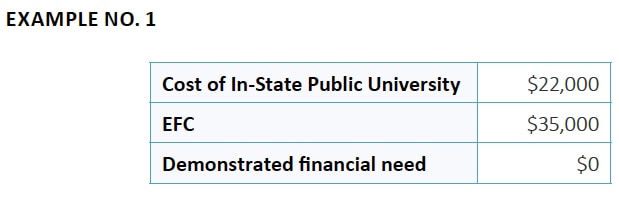
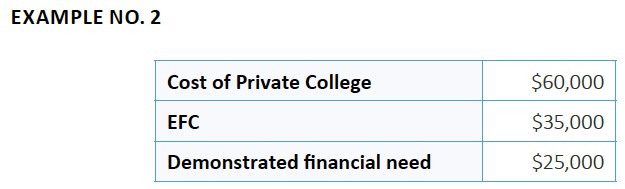
Determining if a student will be eligible for need-based aid requires subtracting the EFC from a school’s cost of attendance. The more expensive the school is, the more likely the student would qualify for financial assistance.
no 1
no. 2
In the first example, the student wouldn’t qualify for any need-based help because the family’s ability to pay exceeds the cost of the school. In the second scenario, however, the same student would be eligible for up to $25,000 in need-based aid from the private college because the price of this institution is far more expensive and exceeds the family’s EFC.

No. 3:

Families, who discover that they have a high EFC and aren’t eligible for need-based financial aid, should look for schools that provide merit scholarships that are given regardless of need. Most schools fall into this category.

No. 4:

If your EFC is modest, you should search for schools that provide excellent need-based assistance. Far fewer colleges and universities fit into this category.

No. 5:

Families with household incomes of $60,000 to $80,000 and above typically find that they do not qualify for need-based aid at state universities, but they may qualify for need-based aid at private schools.

No. 6:

Families will usually have to pay more for college than their EFC indicates they can afford because most schools do not meet 100% of a student’s demonstrated financial need. Consequently, it’s important to identify the most generous colleges and universities that would consider your child an attractive candidate.

No. 7:

It’s best to get a ballpark idea of what your Expected Family Contribution will be as early as your child’s freshman year in high school. Obtaining a preliminary EFC will give you a rough idea of the minimum amount that you will be expected to pay for college.

No. 8:

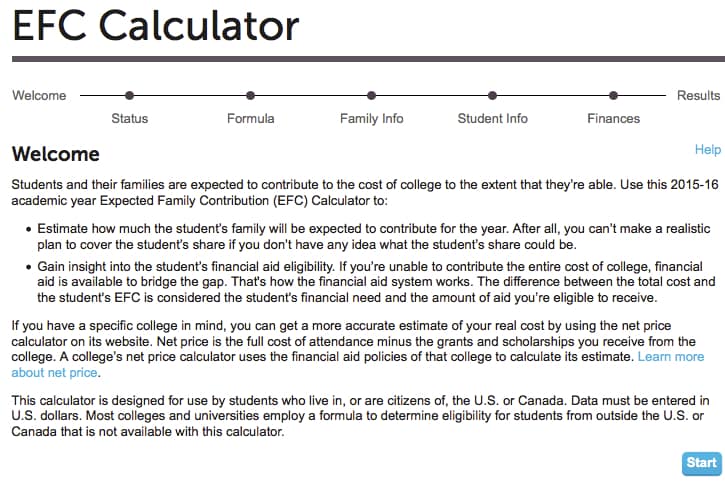
You can obtain your Expected Family Contribution by using the College Board’s EFC Calculator.  With this calculator, you’ll want to obtain your EFC using the federal and institutional formulas. Here is a screenshot of the calculator:
calculator
The calculator will produce an EFC using the federal methodology that is linked to the Free Application for Federal Student Aid.
The calculator will also produce an EFC using the institutional methodology, which is linked to the CSS/Financial Aid PROFILE, which is a product of the College Board. The vast majority of private and public colleges and universities only use the FAFSA while 260 mostly private, selective schools use the PROFILE.

No. 9:

When you complete the FAFSA, you will receive your official federal EFC via an electronic document called the Student Aid Report. The SAR will include the family’s Expected Family Contribution near the top of the report and also provide all the information that the family provided on the FAFSA. Parents should check for accuracy.

No. 10:

If you need to file the PROFILE, you will not receive your EFC from the College Board, which owns and operates this financial aid application. Institutions that use the PROFILE customize their aid applications by choosing from hundreds of different questions so you will end up with a different EFC for each school.

No. 11:

You should ask each PROFILE school for your EFC if the institutions do not include this important dollar figure on your financial aid awards.

No. 12:

Many schools fail to include a family’s EFC on their financial aid awards. Some institutions suggest that including the EFC on their aid letters will confuse families. More likely, schools don’t want to share EFC figures with families because parents would then be able to determine if the package is stingy.

No. 13:

Once you have your EFC and the financial aid package, compare your EFC with what a school is offering. Let’s say that the cost of a school after deducting institutional grants is $39,000 and your EFC is $28,000. That means there is an $11,000 gap between what your EFC suggests that you can pay and what the school wants to charge you.

No. 14:

Plug new numbers into the EFC calculator if your financial situation changes due to such things as a divorce, separation, death, disability, job loss or the care of an elderly parent.

No. 15:

Don’t be surprised if your EFC figures seem too high. The financial aid formulas as flawed and aren’t designed to accurately measure what you can actually afford to pay for college!

Saturday, April 25, 2015

Would You Pay $47,000 for the University of Oregon?

http://www.thecollegesolution.com/would-you-pay-47000-for-the-university-of-oregon/

Last week at the exercise boot camp that I attend on Sunday mornings, I saw a mom who hadn’t been coming to the workouts for several months. The mom is divorced and is trying to support herself as a manicurist.
Her son is a high school senior so I had been giving her some college advice before she stopped showing up on Sundays.
When I saw her, I asked her if her son knew where he would be attending school in the fall.
She frowned and said, “He wants to go to the University of Oregon.”
I was stunned. “Oregon! Are you kidding me?”
I was not optimistic when I asked, “Did he get any money from Oregon?”images-2
I wasn’t surprised when the mom said that her son’s package consisted entirely of loans for a school that will cost a nonresident at least $47,000.
The San Diegan teenager, who was attracted to Oregon because of its tremendous football success (!!!) is not dissuaded by the price tag.
Eighteen-year-olds seem immune to large price tags when loans can temporarily keep them from dealing with harsh financial realities. Making matters worse, the teachers at this teenager’s school are encouraging him to go to Oregon! Ryan’s dad is exploring how to make this work which would include a huge debt.

Universities Charge More When They Can

The steep price that Oregon is charging Ryan illustrates a classic supply-and-demand phenomenon. Public universities that are extremely popular with their own residents, as well as teenagers from other states, don’t have to offer much of a financial enticement (if any) to attract outsiders to their campuses. This same phenomenon is played out among private colleges and universities.
The Oregon flagship not only has a successful football program, but it is located next to the nation’s most populous state that doesn’t have enough capacity to educate its own college students. So many Californians are attending the U. of Oregon that it’s been called the University of California at Eugene.

Elite flagships are recruiting high-income students

university of michigan xx
U. of Michigan
When students contemplate the possibility of attending college outside their own state, they often put prominent state flagships on their dream lists. A major reason for this is because the typical teenagers and their parents unfortunately know of very few colleges and universities.
If you aren’t rich, however, I’d suggest that you not fall in love with name brand schools like the Universities of California, Michigan, Virginia, Texas or that are located in desirable geographic areas such as the University of Colorado and University of Vermont (both near mountains) and the University of Arizona and Arizona State (both temperate weather).
These schools and others with strong brand names are hungry for outsiders who can bankroll an education that can cost more than $200,000.
Some of these institutions, such as Michigan, provide token merit scholarships –  $5,742 is the average – but that won’t go far when you will be paying private school prices for state educations. Some prominent state universities, such as UCLA, UC Berkeley, UC San Diego, don’t  award any merit scholarships to outsiders.

Getting Into a Flagship

It’s easier to gain admission into prestigious flagships as an outsider now because these institutions need the extra cash. Finding out-of-state sugar daddies is one way for these schools to attract new dollars. And it’s easier to entice rich students to their campuses than for these institutions to get serious about making meaningful structural changes.
I wrote a story for my college blog over at CBS MoneyWatch a few years ago about a dad, who works at Columbia University, whose daughter had planned to attend the University of Michigan. She attended the new student orientation in the summer before her dad noticed that he had misread the bill. He thought the tuition was going to be a total of $19,000, but that was the price per semester. Now the school’s tuition is $4,000 a year more.
Affluent students are the ones attending these popular schools because state universities almost never give need-based aid to nonresident applicants who can’t afford the tab. And that’s why I never would have recommended that Ryan apply to Oregon. The most he could have hoped for would have been a token scholarship and that would have barely made a dent in the cost.
As these flagships attract more higher-income students within their own borders and beyond, low and middle-income residents are getting less access to these institutions. In essence, these mighty institutions are becoming privatized.

State Schools Off the Radar

Unless you can afford to pay private-school prices for an education at a public university, I would suggest throwing a much wider net. If you look beyond the most popular flagships, plenty of state universities offer significant discounts to nonresidents.
The New York state universities (SUNY’s) , for instance, represent some excellent values. Unlike many states, New York state has continued to support its public universities at levels other state legislatures have long abandoned.
Another potential great buy is the University of Minnesota in Minneapolis, which is a bargain compared to Michigan. I once asked a teenager why he thought that the University of Michigan is so much more popular than the U. of Minnesota, which is located in the Twin Cities. “Minnesota is cold,” he replied. I mentioned that Michigan is hardly a temperate climate. My theory is that Michigan has enjoyed a long and storied tradition of success in the Big 10 athletic conference and the Minnesota Gophers have not.
University of Utah
University of Utah
The scholarships for nonresidents can be more generous and prices much lower to begin with at schools that have to work harder to attract nonresidents. University of Arkansas, for instance, has tons of scholarships for nonresidents. A huge plus at Arkansas is the tremendous amount of internships for students because of Walmart’s proximity. Walmart requires major corporations to maintain an office in Arkansas so there are hundreds of corporate outposts in the state.
The University of New Mexico has impressive scholarships even for students with a 3.0 GPA and it’s located in a city (Albuquerque.) I am hoping that a daughter of a family friend, who is a gifted dancer, ends up at the University of Utah’s modern dance program, which is considered as good, if not better, than Julliard’s.
I could go on and on about the opportunities at state universities beyond the popular ones, but I think you get the picture.

Bottom Line: 

If you want to lock in better prices, you need to be more imaginative when looking for schools. You can’t continue to fish in the same pond as everyone else!

Thursday, April 23, 2015

7 things high school juniors can do to prepare for college

http://www.chicagotribune.com/suburbs/la-grange/lifestyles/ct-dlg-mash-college-prep-tl-0423-20150417-story.html

Now that seniors are committing to colleges and firming up plans for the year ahead, it's time for juniors to get serious about the future. But it's easy to feel lost and overwhelmed when trying to get ahead of the game. We consulted everyone from college experts to teens who just went through the process themselves to figure out the seven things every junior should do this semester to get the ball rolling on senior year.
1. Build relationships with teachers
It's a great time to take stock of the teachers you've connected with, build new relationships and strengthen existing ones. When senior year begins, consider asking those teachers for recommendation letters.

"Request letters from teachers who you know well and who have a positive impression of you," said Jennifer Cox Bell, national director of programs and partnerships at College Advising Corps, a nonprofit that aims to increase the number of underrepresented students entering college.
Following this advice will give you more confidence when asking for recommendations or advice. Make sure to continue connecting with these instructors so it's not a surprise when you ask for a favor.
2. Fight early-onset senioritis
You're not a senior just yet, so don't fall victim to a slow second semester.

8
"Good grades in high school are critical for college admissions—including junior year," Bell said. "Take rigorous courses. Don't be discouraged from applying to college if you have some lower grades on your transcript though. It's never too late to make academics a priority, and colleges accept students at all GPA ranges."
Remember that boosting your grades now will pay off later. And don't forget to check in with your dream schools to ensure you're fulfilling admission requirements.
3. Start researching colleges now
Yes, now. Get familiar with sites like collegeboard.org, studentaid.ed.gov andcommonapp.org. Before the year ends, reach out to admissions officers at your favorite schools and inquire about upcoming visits and campus events.
"Many high schools also schedule field trips to local colleges, so be sure to ask your school counselor or teachers about those opportunities," Bell said.

While you're at it, ask your college counselors if and when admissions officers will be visiting your school. Don't miss out on those super personal opportunities.
4. Slay your ACT, SAT and/or AP exams
Preparation is the key to success with big tests you'll take this year and next. First, figure out which tests you'll need to take to get into your dream schools. If you don't know, check the admissions requirements and talk with your college counselor.
Some schools will let you submit either an ACT or SAT score. In that case, figure out which test best suits your strengths and evaluate your options.

7
"Study a lot before the ACT," said Kenwood senior Jenna Washington. "Find out your weaknesses and the score you need to attend your dream school. If you don't get the score you want, you can always retake it."
5. Hit up a college fair
Attending college fairs and events can really help you get to know your options. They give students an opportunity to talk with the people who work at the school and know it best.
Before you go, check out which colleges will be attending so you have a better idea of which booths you want to visit.
"It is a great first exposure," said Lianne Musser, college center coordinator at Lyons Township. "This is a great place for juniors to understand how much schools cost and what money is available from schools. These fairs will help students understand what questions to ask."
6. Take your senior schedule seriously

Next year is the best time to branch out from those run-of-the-mill classes and focus on what actually interests you. Find out if your school offers an independent study program, where you can dive into subjects like Russian literature or microbiology.
"Try to take AP classes you're sure you'll pass or take college bridge classes," said Brent Bradford, a freshman at Tennessee State University. "Taking those classes will help to get the necessary college requirements and obviously the field of work you're interested in."
If that's not an option, check out advanced courses in the subjects you enjoy most and might consider for a college major. These specialized classes could help land you an internship or put your application over the top in the admissions process.
7. Start looking for scholarships
After you take the ACT, you might think it's time to sit back and take a break from college planning. Sorry, but you've still got work to do. Toward the end of the school year and throughout the summer, start applying for scholarships that will put you ahead of the curve and ease some of the financial struggles you'll face senior year. Your future self will be very proud of you.
"Research your dream schools and know when you are eligible for scholarships," Musser said. "Lots of schools have a priority deadline in the winter, which you must have applied by to be eligible for any money they give. Make sure to look up those deadlines on school websites and keep them in mind."
This story was previously published in The Mash, a Pioneer Press sister publication for Chicago-area high schools and students. One of the authors, Claire Quinlan, is a senior at Lyons Township High School in La Grange.


Thursday, March 26, 2015

Creating the College List


 COLLEGE STUDENTS
Originally posted: http://www.huffingtonpost.com/jeannie-borin/creating-the-college-list_b_6928262.html?utm_hp_ref=college&ir=College

For many, there are colleges that students are intent on going to, expect to be accepted, and can afford. It could be a state university, a school that friends are going to, a school students have been told about, or an elite private school where some are qualified.
However, these college factors do not cover numerous variables about college life that are significant such as academics and affordability. Creating the college list is individualized and personal. If you are flexible and your goal is to attend a university that is a good fit for you, your interests, and your future, then creating a college list is paramount and should involve the following factors:

1. Create files and stay organized. Use a specific notebook or online files for any notes, communications, ideas, and questions. Anything that relates to your eventual college list should go in one place. Each college should receive a designated page that can be referred to later for essays, interviews and more.

2. Make a list of your priorities. What are you looking for in a college? Do you like a smaller college in a rural area or a larger public university in big city? a large student enrollment or smaller? Academic programs of interest? Activities? Opportunities? Climate?

3. AFFORDABILITY For some, this is not an issue. For most, it is. It is important to know what your family is able and willing to pay in out of pocket expenses. Also, it is wise to consider you and/or your parent's willingness to incur debt. If there is a gap between the Expected Family Contribution and the Cost of Attendance, you will want to look for schools that provide a large percentage of need through Federal Aid and have a solid record in providing merit or Institutional Aid. If you are not eligible for significant need-based aid, then you are going to want to apply to schools where you will be in the upper 25 percent of applicants as far as GPA and test scores. Statistics on schools' generosity or lack of are readily available. It is good to work with a college financial planner who is familiar with using the numerous resources available.

4. Explore colleges within your area that are different -- a public and private college. Visiting gives students a much clearer idea of what they want and what they don't!

5. ADMISSIBILITY Use resources such as College Data, College Board's Big Future, College Results, Fiske Guide, the college website and a slew of others. Create your long list of schools for further review. Note the admission requirements. Do remember that any guide or website does not know you. So, it is best to review with a counselor to find your best fit.

6. Make a list of factors that are your priorities: activities, career center, academics, housing, athletics, size and location, cost

7. Once you have completed your research, it's time to put together a preliminary college list. It's best to create categories of reach, 50/50 and likely acceptance. This list could have 20-30 colleges on it. Once this is complete, review your personal criteria, do further research and begin to narrow your list. Narrow your categorized list to your working college list to include about 10 colleges. Try to accomplish this by the start of summer so you are prepared when the Common Application and other colleges release their applications for your season. Don't hesitate to get help! Creating your college list can get complicated and you most likely will have many questions.

Monday, March 9, 2015

Does It Matter Which College Your Child Chooses? Probably Not.

Between now and April 1, parents of high school seniors will be eagerly trolling their mailboxes, hoping to spot fat, cheer-worthy college acceptance envelopes. We long to see proof that everything our kids have done so far is paying off: Sports practices! Theater rehearsals! Debate teams! Chess clubs and robotics!
Alternatively, we’re seized by anxiety at the sight of those slender envelopes containing rejection letters saying our kids didn’t make the cut. Those letters tempt us to feel like our kids are failures and we are, too.
It’s natural that we feel this way, I suppose. After all, we know the college admissions process is competitive because the colleges keep telling us so, in all of their glossy literature trumpeting their supposedly unique features, like “hands-on learning,” “cutting-edge facilities,” and “award-winning faculty.” College enrollment jumped 32 percent between 2001 and 2011, with the number of full-time college students rising 38 percent, according to the National Center for Education Statistics.
Childhood isn’t meant to be a race to the college finish line. It’s meant to be a formative part of life. So is college.
As someone who is both a veteran of the college application process — I’m playing the waiting game with our youngest of five at the moment — and as a freelancer who writes college admissions materials, I wish I could give every parent of a high school senior a chill pill.  I want them to know what I do: that where your child ends up at college will probably matter a lot less than you think it will.
Sure, it’s nice to get a tony degree from an Ivy, if only for the bragging rights. Or from a school with deep endowment pockets so you don’t have to break the bank. But the reality is that there are about 5000 colleges and universities in this country and nearly every one of them has lots to offer.
In my work, I’m often asked to interview administrators, faculty members and students to determine how to put that school’s best foot forward. Inevitably, I find what I’m looking for: passionate professors; study abroad opportunities; career counseling; caring coaches; and top-notch kids who not only do well academically, but go out and do good in the world. Oh, and lately I’m seeing campus fitness facilities, housing and dining halls that rival world-class hotels.
Yep. Every college, from the smallest under-the-radar school to the biggest university, has cool things for your kid to learn, eat and enjoy.
“You must be so nervous,” a friend said recently. When I looked puzzled, she added, “About where your son’s going to get into school.”
Um, no. Not really. I don’t care where he ends up. What matters is that my son is happy and can continue following his passion for science and engineering as he makes new friends, maybe has a chance to run competitively and check out a few different jobs so he can keep honing his interests and applying what he learns in the classroom. My son will be happy and fulfilled at any of the colleges he applied to — despite the fact that his list of eight schools includes everything from one small city Ivy to one of the nation’s biggest rural state universities.
My son knows this, too. He has watched his brothers and sisters thrive, despite each of them taking a different educational and career path. Of our four, only one was admitted to his top choice: a small, New England independent college. (You know: brick buildings, liberal arts, lots of snow.) He graduated with an English degree and got a great job as a writer at a social media company. Having a degree helped him land the job, but not as much as the freelance writing he’d been doing for web sites while he was in school.
Our other son chose a medium-sized private college in Pennsylvania. He hated its rural location and transferred sophomore year to a city college. His biggest passion in life has always been movies;  he majored in film studies and went to Hollywood after graduation, where he’s now a set designer and art director. Is he successful because of his film studies degree? Partly. But he got his foot in the door because he had spent summers working with a carpenter and knew one end of a hammer from another. Being able to actually build sets meant he could work on them and meet people who gave him a leg up.
Our oldest daughter wasn’t admitted to her first choice college — an Ivy — so she ultimately decided to grit her teeth and attend a state university to save money. She hated it at first, then found her niche in the natural resources college. She got a job immediately after graduation with an environmental engineering company in California and is now in graduate school in Oregon, studying forestry.
Our other daughter wanted to study in Paris, but transferred to a women’s college two years later in search of more competitive academics. After graduating with high honors, she needed a break from academics and worked as a waitress, saving up enough to travel through Brazil. Now she’s happily working in a yoga sanctuary.
It’s a parent’s dream come true to have kids who not only make it through college, but then support themselves doing jobs they love. This dream is achievable no matter where your child goes to school.
It’s a parent’s dream come true to have kids who not only make it through college, but then support themselves doing jobs they love. This dream is achievable no matter where your child goes to school. What matters more than any academic pedigree is that your children pursue their passions outside the classroom — through field work, freelance writing, summer jobs, internships, study abroad programs — and accumulate the necessary skills and direction to pursue careers that engage and fulfill them.
Everything your child has done for the first 17 years of life — from playing tag to National Honor Society, from ballet lessons to video games — has been important simply for the experiences themselves. Childhood isn’t meant to be a race to the college finish line. It’s meant to be a formative part of life. So is college.
Your child will get into one of those schools you’re waiting to hear from. And, if the school turns out to be a bad fit, it’s not tough to transfer. Whatever institution your child ultimately graduates from, what you must hope for is that the education isn’t only about academics or athletics, Greek life or community service, but about educating the whole person in a way that inspires lifelong learning.

Saturday, February 28, 2015

6 tips for deciphering a financial aid letter

Reposted from: http://www.cbsnews.com/news/6-tips-for-how-to-decipher-a-financial-aid-letter/
For high school seniors, the agonizing college admission process is almost over. All that's left for many students is deciding which college they can afford.
Answering this question, however, isn't as easy as it might seem because it requires deciphering financial aid letters. Unfortunately, many colleges and universities send out financial aid letters that are difficult to understand.
So, here are six tips to help you make sense of any financial aid award.
1. Know what should be in every financial aid award.
Award letters should reflect the full cost of attendance. A financial aid letter should include tuition, room/board, textbooks, travel and miscellaneous expenses. The cost of the school, minus any grants/scholarships, will generate your net cost.
"For purposes of comparison, it is important to see how much grant assistance you are being offered and what the net price is," advised Joseph Bagnoli Jr., dean of admission and financial aid at Grinnell College in Iowa.
2. Check for this key figure.
Sometimes what a school fails to include in a financial aid letter creates problems for families.
Few award letters, for instance, include an extremely important figure: the Expected Family Contribution (EFC). This dollar figure tells a family what the financial aid formula has determined the household should be able to pay for one year of college. Without this critical figure in the award letter, it would be impossible to know if a student's package is a good one or not.
For example, let's suppose a family's EFC is $20,000, but the school's cost is $55,000. Ideally, the student would get $35,000 in financial assistance to bridge this gap, and most of that would be in the form of grants and scholarships.
In this hypothetical case, however, the student only received a $10,000 merit award and a federal loan. The $10,000 award wouldn't make a significant dent in the family's demonstrated need for $35,000 in assistance. Without knowing their EFC, the parent and students may not understand that this is a poor award.
If the school does not include the EFC on the award letter, contact the financial aid office and ask what this figure is.
3. Make sure loans are clearly marked.
Some schools' award letters make it difficult to differentiate between loans and grants/scholarships. I've seen letters where the federal student loan has been referred to as "a Stafford" rather than "a federal Stafford Loan." Inserting loans in a package without properly identifying them will make a school look less expensive than it really is.
4. Check out the federal Shopping Sheet.
In an attempt to end the confusion, the federal government created a model financial aid letter called a Shopping Sheet. This model letter clearly identifies what the net price of college would be to a family by providing the cost after deducting scholarships/grants. In contrast, many schools will provide a bottom-line price after subtracting loans. Schools must voluntarily sign up for the Shopping Sheet. Still, seeing what a model financial aid letter looks like can help.
5. Use the College Abacus tool.
College Abacus, a free website that helps families find the net price of schools, offers a financial aid comparison tool. You can take any financial aid letters and plug in the necessary figures to generate a crystal-clear comparison sheet of different awards. You must register to use the tool.
6. Ask questions.
If the financial aid award remains confusing, call the school's financial aid office and stay on the line until you understand. Too much is at stake to just guess.

Thursday, February 26, 2015

Stop Fixating on These Colleges!

by  on February 22, 2015 in Admission practices, Admissions, Applying,Colleges, Ivy League, Parents

A lot of the parents attending my current online class on how to cut the cost of college are affluent and highly educated.
Quite a few of these moms and dads attending my course have indicated to me that they would like to see their children attend elite schools.
Not surprisingly, these parents have expressed concern about the cost of these highly prestigious schools. What many of these institutions are charging for a bachelor’s degree EXCEEDS a quarter-million dollars for those who don’t qualify for need-based financial aid. And for parents with two or more children, the costs are beyond staggering – even for those with comfortable six-figure incomes.
One of the things these parents are learning is this:  the schools with the very shiniest brand names don’t University-Rankinghave to bother giving merit scholarships to highly accomplished students from high-income families. Why?  Because there are plenty of wealthy parents who will pay ANY amount to get their children into one of U.S. News & World Report’s darlings. A school like Harvard or Stanford could charge $1 million or $2 million for a bachelor’s degree and they’d still reject many teenagers.
Once this reality sinks in, these parents sometimes begin wondering if they should plunder their retirements accounts and/or take on debt to underwrite a degree at one of these elite schools that seem (notice the emphasis on seem) to have a monopoly on dispensing golden tickets.

Yale vs. Northeastern University

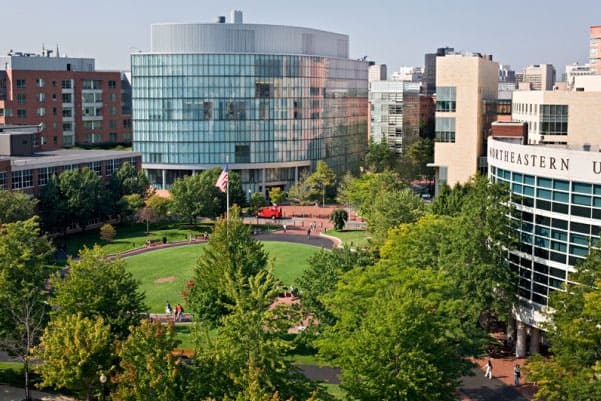
I got an email last week from a mom struggling with this very issue. Her son got into Yale with barely any financial aid andNortheastern_University_1 also got a full-tuition scholarship toNortheastern University.  The parents, who are in their 60s, would have to borrow six-figures to make Yale  financially possible.
To me this is an absolute no-brainer decision. Here was my advice, “Go to Northeastern!!!!”
This case also illustrates something else that’s common – a high-income teenager who gets nothing from an Ivy League school can routinely snag big, fat merit scholarships from countless other schools.
I’ve heard from so many moms and dads focused on underwriting an elite-school education through my course (there is still time to register if you’re interested), in my talks and through my blog, that I felt compelled to write a post pointing out some key things these parents need to know.

You don’t have to go to an elite school to succeed!

This seems incredibly obvious to me, but it isn’t to many parents in wealthy communities that seem to view 13527586992j82fgetting into prestigious colleges as some kind of trophy sport. For some parents, it becomes an obsession while their kids are still in diapers.
A Princeton admission rep once told someone I know that parents with preschoolers ask her what private schools their children should attend to boost their ultimate chances of a Princeton admission. Wow!
Even if I was to concede (and I’m definitely not!) that all the best jobs in the entire country go exclusively to the graduates of the most highly ranked colleges and universities, that would leave about 99.5% of jobs left to the rest of us.
If you don’t believe me, take a few minutes some day and look at your LinkedIn contacts. I bet most, if not all, of 64VZAhLthe most successful contacts you have did not attend a trophy school!
I made the LinkedIn suggestion recently when I was giving a talk at a financial conference in Las Vegas that attracted some extremely successful, fee-only financial advisors from across the country. When someone asked about the elite school advantage (he assumed there was one), I reacted by instructing anyone who had attended an Ivy League school to raise his/her hand. No one in the room did.
There have been some excellent and highly touted studies on whether an Ivy League bachelor’s degree conveys a professional advantage for students. The main conclusion of these papers was this:  students who attend Ivy League institutions and equally bright students who apply but get rejected from Ivy League schools end up making the same amount of money in their careers. These are bright and motivated students, after all, who can succeed wherever they go to school.
There was an exception to the research finding.  Minority and first-generation students who don’t enjoy the same advantages as the students whom the Ivy League schools specialize in educating – wealthy students  – did gain an advantage from attending these schools.

This Should Make You Feel Better

What should make parents feel better is this conclusion from Alan Krueger, the famous Princeton economist and coauthor of the studies:
He pointed out that the average SAT score at the most selective college that students apply to is a better predictor of their future earnings than the average SAT score at the college they attended. Read that again and let that sink in!
Here are excellent summaries from The New York Times and the Brookings Institute on what the famous Ivy League studies uncovered:

Revisiting the Value of Elite Colleges

 Who Needs Harvard?

It’s What You Do in College That Counts!

A Gallup survey conducted with Purdue University last year provided further evidcaitlinence that people should really stop fixating on the elite schools.
The survey results indicated that the type of institution that college graduates attend matters less to their future happiness at home and work than the experiences they have at whatever college that they end up at. In fact, the survey concluded that whether respondents attended an elite school, a public flagship, a  private college or a regional state school didn’t matter at all.
I wrote the following blog post about this survey and used my daughter Caitlin (see photo), a Juniata College graduate, to illustrate how you can be incredibly successful at a college that most people have never heard of:

How My Daughter Made the Most Out of College

Striving for elite schools can cripple teenagers mentally

Finally, I’ve left the most important factor in the college-admission rat race for last. What mental-health price are teenagers paying who are aiming for these elite schools?
I had a mom in my class wonder last week if the burnout her daughter, a junior, is experiencing is normal. The girl is taking four AP classes and a honors class on top of all her extracurricular activities. The mom is worried how her daughter is going to do when she’ll face this crushing load while visiting colleges, applying to schools and taking her standardized tests.
I encounter this issue a lot when I talk at schools in high-income areas with ambitious parents. What I tell them is that their children do not have to be super human. There are many schools that would love high-achieving students whether they take four AP classes a semester or two or one and will reward them with merit scholarships.
I see a lot of panic at these schools where parents worry that other students are pulling ahead academically so they pile on more AP classes. At the high school where my husband attended, the premiere public school in Denver, some students are starting Calculus as freshmen to try to gain an edge. It’s nuts!
This academic escalation can have tragic consequences.
I’ll be giving a talk at Gunn High School in Palo Alto this spring (I’ve given several talks at Silicon Valley high schools) that has experienced eight student suicides in roughly the past five years. 
I would highly urge parents of teenagers attending these pressure-cooker high schools to read a wonderful book written by Madeline Levine entitled, The Price of Privilege: How Parental Pressure and Material Advantage Are Creating a Generation of Disconnected and Unhappy Kids.
Here is a guest post from my blog recently that synthesizes Levine’s message that is definitely worth reading:

Why Affluent Teens Are Miserable

Bottom Line:

There are amazing colleges and universities in this country, many of which are under the radar, that offer excellent opportunities for their students.
It’s important to know that nationally around 75% of students get into their first-choice school. At most colleges and universities, it’s actually a buyer’s market not a seller’s market. Students have many, many choices if they are savvy enough to not just look at the same old three or four dozens schools that smart, high-income students tend to focus on.